Here's what most AI consultants won't tell you upfront: not every business is ready for AI — and that's okay.
Rushing into AI implementation without the right foundation is like building a house on sand. It looks impressive until the first storm hits, then everything collapses.
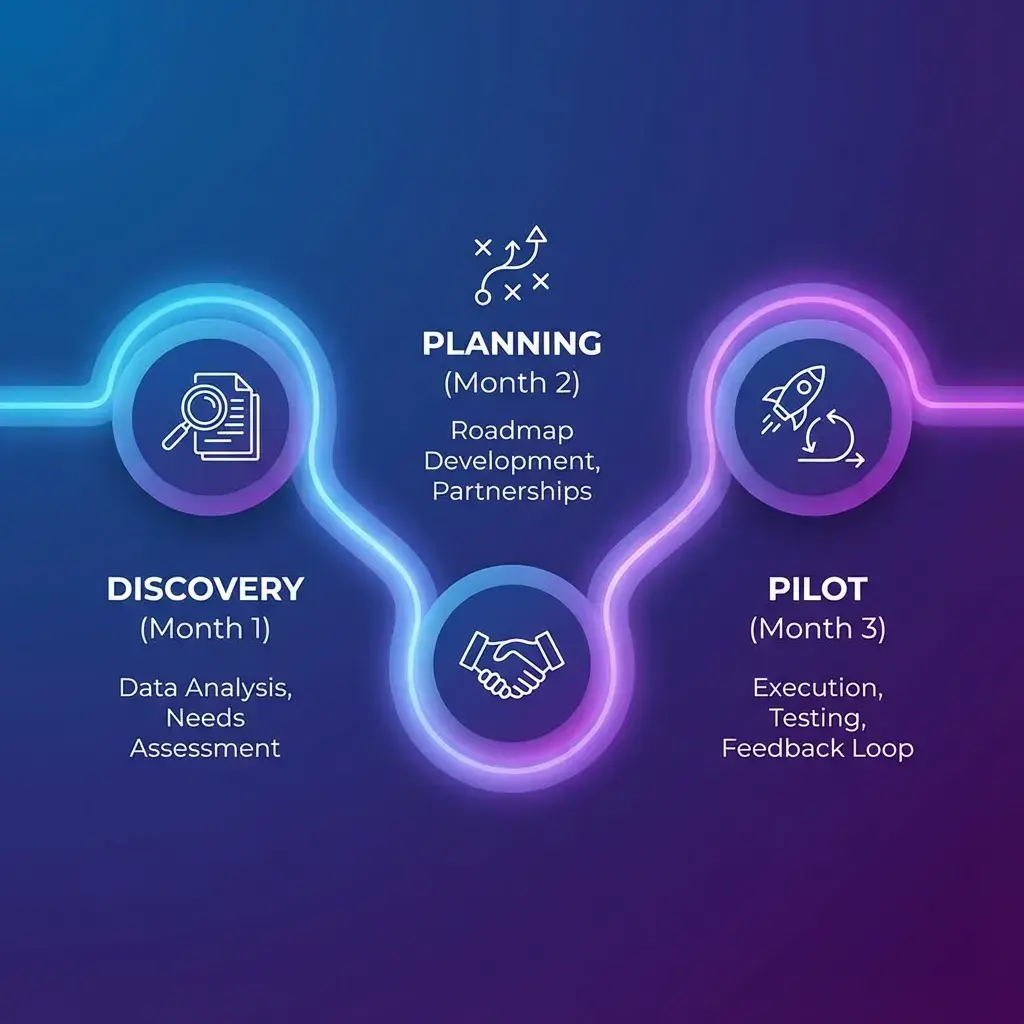
But if you ARE ready? AI automation can transform your operations in 90 days or less — reducing costs, improving customer satisfaction and freeing your team to focus on growth instead of grunt work.
Let's figure out which category you're in.
Why Timing Matters More Than You Think
I've seen two types of businesses approach AI. Type A has clear processes, good data hygiene and specific problems to solve. Their AI implementation delivers 3–5x ROI within six months. Type B jumps in with vague goals, messy data and unclear processes. Six months later, they've spent money with little to show for it.
The difference isn't the technology. It's readiness.
The good news: Readiness isn't about company size or tech sophistication. A 15-person business with organized processes can implement AI faster than a 500-person company with operational chaos.
Sign #1: You're Drowning in Repetitive Tasks

What this looks like: your team spends hours on copy-paste work between systems, the same questions get asked dozens of times per day, you're manually generating reports that follow predictable patterns, customer inquiries pile up because there aren't enough hours in the day, and employees say "I wish this was automated" at least weekly.
Why it matters: repetitive tasks are AI's sweet spot. If humans are doing something predictable and rule-based over and over, AI can almost certainly do it faster, more accurately and at a fraction of the cost.
Real-world example: a logistics company had 3 employees spending 20 hours per week manually routing shipments based on weight, destination and carrier availability. We built an AI system that automated 85% of routing decisions. Those 60 person-hours per week were redirected to customer relationship management and strategy. Revenue increased because the team could focus on growth, not data entry.
Ask yourself: what tasks does your team complain about most? Where do you see the same work happening again and again? What would free up if you could automate just one process? If you answered "yes" to any of these, you've got a prime AI opportunity.
Sign #2: Your Data Exists (Even If It's Messy)

What this looks like: you have customer records in a CRM or database, historical emails, chat logs or support tickets are stored somewhere, sales data or operational metrics are tracked — even if data lives in multiple places, it exists in digital form.
Why it matters: AI learns from data. You don't need perfect data to start but you need some data. The minimum threshold: 6–12 months of relevant data in digital format.
Real-world example: an e-commerce brand thought their data was "too messy" for AI. They had customer service emails scattered across Gmail, support tickets in Zendesk and order data in Shopify. We didn't need perfect data — we needed enough to train a chatbot on common questions. Within 4 weeks, it was handling 60% of routine inquiries, trained on their "messy" historical data.
Ask yourself: do you have at least 6 months of customer interaction data? Is your business data stored digitally (even across multiple tools)? Can you export lists, reports or records from your current systems? If you have data living somewhere digitally, you're probably ready.
Sign #3: Your Customers Expect More Than You Can Deliver

What this looks like: customers want instant responses but your team can't keep up, support requests come in outside business hours with no one to answer, competitors are offering faster service and you're losing deals because of it, or your NPS and customer satisfaction scores are stagnating.
Why it matters: customer expectations in 2026 are shaped by Amazon, Netflix and AI assistants. They expect instant, personalized, 24/7 service. AI is often the only way to meet these expectations without ballooning your headcount.
Real-world example: a B2B SaaS company was losing trials to competitors because leads had questions during evenings and weekends — and by Monday morning, they'd already signed with someone else. We implemented an AI-powered virtual assistant that answered product questions 24/7, booked demos automatically and qualified leads before they hit the sales team. Trial-to-paid conversion increased by 28% in the first quarter.
Ask yourself: are you losing customers or deals due to slow response times? Do you get inquiries outside business hours that go unanswered? If customer expectations are outpacing your capacity, AI levels the playing field.
Sign #4: Your Team Is at Capacity (But You're Not Ready to Hire)
What this looks like: everyone's calendar is full but work keeps piling up, you're hesitant to hire because margins are tight, overtime is becoming the norm and burnout is a real risk, or strategic projects get delayed because everyone's buried in operations.
Why it matters: AI doesn't replace your team — it multiplies their capacity. One person with AI support can often do the work of 2–3 people doing things manually. The math: if one AI solution costs $2K–$5K per month but replaces 20–40 hours of work per week, you're getting full-time capacity at a fraction of hiring costs — with no benefits, no vacation, no turnover.
Real-world example: a digital marketing agency was turning down clients because their content team couldn't scale. We built an AI content assistant that generated first drafts based on client briefs, maintained brand voice consistency and handled research and outlining. Their 3-person team could now handle the workload of 6 people. Instead of hiring they took on more clients and increased revenue by 40%.
Ask yourself: is your team consistently working overtime? Are you delaying strategic initiatives because of operational overload? If capacity is your bottleneck, AI is your multiplier.
Sign #5: You Have a Specific, Measurable Problem to Solve

What this looks like: you can describe your problem in one sentence, you know what "success" looks like in numbers, the problem is costing you time, money or customers, and you're willing to invest 3–6 months to solve it properly.
Why it matters: vague goals produce vague results. "We want to be more efficient" isn't actionable. "We want to reduce support response time from 6 hours to 30 minutes" is.
Good problem statements: "We lose 15 hours per week to manual data entry between our CRM and accounting software." "Our support team can't respond to 40% of inquiries within our 2-hour SLA." "We're missing qualified leads because it takes 48 hours to follow up."
Bad problem statements: "We want AI to make us better." "We need to automate stuff." "Competitors are using AI so we should too."
Ask yourself: can you describe your biggest operational problem in one sentence? Do you know what success looks like numerically? If you can articulate a specific problem with measurable impact, you're ready to move forward.
3 Signs You're NOT Ready for AI

Sign #1: Your Processes Are Chaotic. Every team member does things their own way, there are no documented workflows, "it depends" is the answer to most process questions. AI automates existing processes — it doesn't create them from scratch. If your process is "whatever John does in his head," AI can't replicate that. You need to document and standardize first, then automate second. Timeline: 2–4 months of process cleanup before you're AI-ready.
Sign #2: You're Looking for a Magic Solution. You expect AI to "fix everything" without defining what "everything" means, you want results in 2 weeks with a $500 budget, or you think AI will solve fundamental business model problems. AI is powerful, but it requires clear objectives, realistic timelines (8–16 weeks), reasonable budgets ($10K–$50K initial) and team buy-in. Approach it as an investment, not a quick fix.
Sign #3: You Have Zero Digital Infrastructure. Most of your business runs on paper, phone calls and in-person conversations. You can't build AI on top of analog systems. Start digitizing critical processes, build digital habits for 6–12 months and collect data systematically. Once you digitize, you'll see benefits before AI — then AI will amplify those benefits.
The Readiness Scorecard: Where Do You Stand?
Give yourself +1 point for each "yes": you have repetitive tasks eating up significant time, you have 6+ months of business data stored digitally, customer expectations exceed your current capacity, your team is at capacity and you're hesitant to hire, and you have a specific measurable problem to solve.
Subtract 2 points for each "yes": your processes are chaotic and undocumented, you're looking for a quick fix or magic solution, and you operate primarily on paper or analog systems.
Your score: 4–5 points: Highly ready — AI can deliver impact within 90 days. 2–3 points: Moderately ready — start with your biggest pain point. 0–1 points: Borderline — tighten up 1–2 foundational elements first. Negative: Not ready yet — focus on process documentation and digital infrastructure for 3–6 months, then reassess.
Next Steps: Your Personalized Action Plan
If you scored 4–5 (Highly Ready): book a consultation this week. You could have an AI solution in production within 90 days with 3–5x ROI expected within the first year.
If you scored 2–3 (Moderately Ready): start with one high-impact problem. 60–90 days to implement a focused solution, 2–3x ROI as you prove the model.
If you scored 0–1 (Borderline Ready): document your top 3 most time-consuming processes, start tracking key operational metrics digitally and identify one repetitive task that's low-risk to automate.
If you scored negative (Not Ready Yet): that's okay. Digitize at least one core business process, implement basic CRM or project management software and get 6 months of consistent digital data collection. Revisit AI in 3–6 months.
The businesses winning with AI aren't the ones with perfect conditions. They're the ones who honestly assessed their readiness, addressed the gaps and moved forward strategically.
Ready to find out where you stand?
Let's discuss your readiness honestly — your highest-impact use case, what gaps (if any) to address first, and what realistic results look like. Free consultation, no pressure.
Irfan Malik is the CEO and Founder of ibute, with 20 years of experience helping businesses leverage custom software and AI solutions to scale efficiently. He specializes in making complex technology accessible and actionable for business leaders.
Frequently Asked Questions
How do I know if my business processes are ready for AI?
What if I scored negative on the readiness scorecard?
Can I start with just one small AI project to test the waters?
What's the typical timeline from 'ready' to seeing results?
How much should I budget for my first AI implementation?
Need a clear path forward?
Get a custom AI roadmap — tailored to your stack, timeline and budget.
Talk to an Expert →