
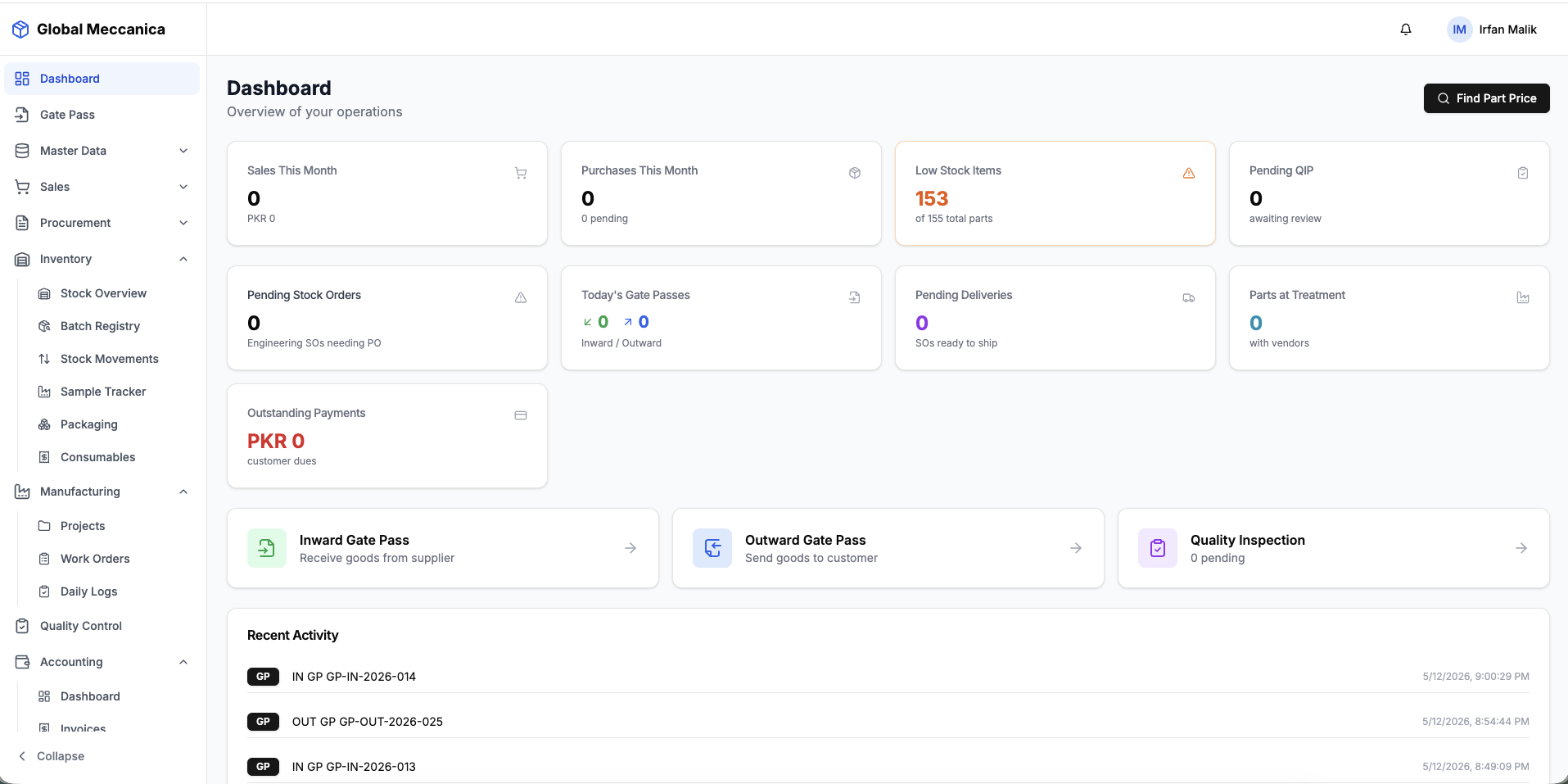
ibute built a custom ERP for Global Meccanica, a precision-parts manufacturer whose parts travel through a sequence of specialized external vendors. Six modules replaced 50+ SAP transactions, with native multi-hop subcontracting and quality wired into the inventory state machine. Delivered in 12 months with a team of 8 specialists.
The Challenge
Global Meccanica is a Pakistan-based precision-parts manufacturer. Their parts travel through a sequence of specialized external vendors (forging here, heat treatment there, grinding somewhere else) before returning to inventory as finished goods. The flow is different for every part. A simple bracket might pass through two vendors; an aerospace crankshaft might pass through five.
For years, their team tracked this in spreadsheets and WhatsApp threads. As volume grew, the cracks showed: parts went missing, quality data sat in PDFs nobody could query and vendors got paid for batches the warehouse hadn't even received.
What they tried first: SAP demos came in at $100k+ before customization and required months of consultant training. Odoo was cheaper but couldn't natively model multi-hop subcontracting without dozens of fake inward/outward gate passes per part. Both approaches forced the business to bend around the software instead of the other way around.
Why custom, not configured
We sat with the operations team, the warehouse guards, the quality inspector and the accountant for four days. What we heard, repeated by everyone, was a different version of the same complaint: "the existing tools make me do work that the system should already know."
That told us the fix wasn't to license another generalist ERP and configure it. The fix was to build six tight modules that matched the actual flow on the shop floor, and let the system do the bookkeeping in the background.
The Ping-Pong Problem
In precision manufacturing, parts rarely follow a straight path. They move back and forth between the warehouse and a sequence of specialized vendors. The team came to call this the ping-pong flow.
Legacy ERPs handle this by recording every leg as a separate inward/outward gate pass at the main warehouse, even when the part never physically returns. The result: more paperwork, more places for inventory to go out of sync and no real-time view of where anything is.
The PartNexus insight: We treat vendors as first-class locations. A part can ship directly from one vendor to another and the inventory ledger just… knows. No fake gate passes. No reconciliation at month-end. The PO chain stays intact end-to-end.
Our Approach
We built PartNexus around six modules: not screens, not menus, modules. Each one earns its place by replacing several legacy transactions with a single intent-driven flow. The whole ERP fits in a primary nav with six items.
Intent-based, not transaction-based
Gate passes have three types (Inward / Outward / Consumable) instead of SAP's five, because that's the only distinction the floor actually cares about.
Quality is architectural
Parts can't be sold or moved until they've passed QIP. It's not a configuration option; it's wired into the inventory state machine.
Math runs in the background
Costing, BOM explosion, billing: all auto-derived from weight, rate and routing. Nobody types a unit cost twice.
Six Modules That Replaced 50+ Screens
Each module is built around a single user intent. Roles are tight: a gate guard sees only gate passes; a manager sees costing; an accountant sees the ledger. The same data, three very different windows into it.
Module 01: Smart Gate Pass Hub
Three intent-based gate pass types replaced five legacy ones. Guards register parts blind. The system links the PO in the background, preventing lazy counting and short shipments.
Before (SAP)
- 5 different gate pass types
- Guards see expected quantities
- No PO chain enforcement
- Manual reconciliation at month-end
After (PartNexus)
- 3 intent-driven types only
- Blind security verification
- Blocks inward if no active PO
- Auto-reconciled in real-time
Module 02: Enforced QIP (Quality Inspection Plan)
Incoming parts sit in Pending QIP inventory until inspected. They can't be sold, can't be moved, can't even be seen by sales. Quality stops being optional.
Module 03: Multi-Hop Subcontracting
The headline feature. Parts move vendor-to-vendor without breaking the PO. Virtual transfers shift inventory balances without fake paperwork. Final billing only triggers when the part returns and passes QIP.
Module 04: 5-State Inventory
Inventory isn't just "in stock" or "not". Every part exists in one of five states at all times (in stock, committed, pending QIP, at vendor or rejected), so managers always know what's available, what's reserved and what's stuck.
In Stock
Available for sale or allocation
Committed
Reserved against a sales order
Pending QIP
Awaiting quality inspection
At Vendor
Out for subcontracting
Rejected
Failed QIP (return or scrap)
Module 05: Multi-Company Accounting
A full accounting sub-system tailored for manufacturers: multi-entity, automatic tax handling, draft billing from work orders, petty cash. No QuickBooks export ritual.
vs SAP & Odoo
We've sat on the wrong end of an SAP implementation. We've watched a client try to model multi-hop in Odoo and end up with a 23-step macro. Here's how the three approaches compare for a manufacturer with this kind of flow:
SAP / Oracle
- Setup cost: $100k+
- 50+ separate transactions for subcontracting
- Complex MRP config for multi-hop
- Months of training required
- Fake inward/outward gate passes
PartNexus
- Low fixed-fee build
- 6 to 8 optimized flows
- Native multi-hop out of the box
- Hours to learn (intuitive UX)
- One-click virtual transfers
Under the Hood
The brief from Global Meccanica was: "don't break, don't lie to me about inventory, and I should be able to log in from my phone at the factory and see what's happening." The architecture is shaped by those three constraints.
Transactional integrity
Every multi-step update runs inside a Prisma transaction. No half-completed states, ever.
Full audit trail
Every part movement, gate pass and work order status transition is logged. Trace any finished part back to its supplier batch.
Performant schema
PostgreSQL with strict typing: distinct tables for suppliers, vendors and customers. No polymorphic party table, no slow joins.
Role-aware security
Gate guards can create gate passes but cannot see unit costs or ordered quantities. Sanitized payloads, scoped queries.
Building a custom ERP yourself?
Tell us about your operation. We've shipped six ERPs in five industries and we'll tell you honestly whether you need a build or a configure.
Schedule a ConsultationThe Outcome
~90%
Reduction in time spent reconciling inventory between warehouse and vendors
Real-time
Visibility into parts at every vendor (no more WhatsApp threads)
Zero
Premature vendor payments, because billing is gated on accepted QIP quantity
Lessons Learned
1. Configure-vs-build is a real decision, not a default
The reflex in 2026 is "don't reinvent the wheel, just configure Odoo / SAP / NetSuite." That's correct most of the time. But when your core flow doesn't fit the wheel (and PartNexus's multi-hop, vendor-as-location model genuinely doesn't fit any major ERP), configuration becomes a tax that compounds forever. Building was cheaper in year three.
2. The shop floor knows the answer
Every meaningful design decision in PartNexus came from a guard, an inspector or an accountant, not from us, not from the CEO, not from a Gartner report. The four days we spent shadowing operations before writing code were the highest-leverage four days of the project.
3. Less software, used by more people, beats more software used by fewer
SAP has 5x the features. Nobody at Global Meccanica was using them. PartNexus has six modules. Every one of them is used every day, by the people they were built for. That's the metric that matters.
4. Inventory is a state machine, not a number
The single biggest unlock was treating inventory as five states (in stock / committed / pending QIP / at vendor / rejected) instead of one number. Everything downstream (reorder alerts, billing, reporting) fell out of that decision cleanly.
Client Testimonial
PartNexus took us from spreadsheets and WhatsApp to one source of truth. Our guards, inspectors and accountant all look at the same numbers now — and they're always right.