When AI coding assistants first arrived, the math was simple. You paid $10 or $20 per developer per month for a seat license. The developer got autocomplete and the business got a minor productivity boost. It was a predictable software subscription.
But the industry has shifted from simple autocomplete to agentic workflows.
Today, AI agents like Claude Code or Cursor don’t just suggest the next line of code. They read directory trees, run terminal commands, execute tests, analyze error logs, and edit multiple files autonomously.
This shift has changed the economics of software development. We have moved from predictable seat-based pricing to variable, consumption-based token billing.
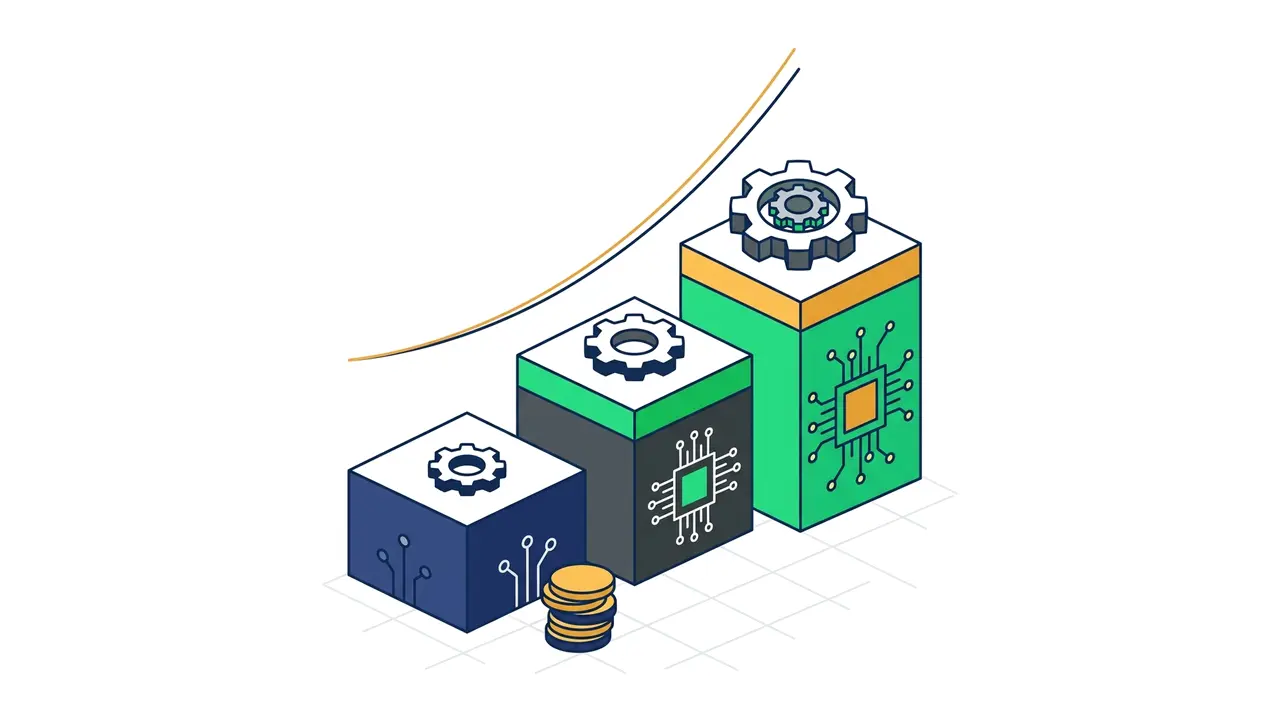
The costs are climbing so fast that Gartner recently published a striking prediction: by 2028, the cost of running AI coding tools will surpass the average software developer's salary.
For business leaders and engineering managers, this crossover changes how we think about AI ROI. Here is a breakdown of why agentic workflows cost so much, where the crossover is already happening, and how to build a sustainable AI engineering strategy.
The Math Behind Agentic "Token Burn"
Why does an AI agent cost so much more than an autocomplete tool? The answer lies in how agents work.
When you ask an AI agent to fix a bug, it doesn't just write a patch. It performs a loop:
- It searches the codebase to find relevant files.
- It reads those files to understand the context.
- It writes a proposed fix.
- It runs the project's test suite in the terminal.
- If a test fails, it reads the error log, modifies the code, and tests again.
- It repeats this process until the tests pass.
Every step in this loop requires sending data back and forth to the AI model. This data is measured in tokens (pieces of words).
Because agents need to read entire files and test logs to operate, their context windows (the amount of information they process at once) get very large.
McKinsey recently highlighted that roughly 60% of an AI agent's operational cost goes toward checking, repairing, and re-verifying code, rather than generating the initial lines. This is the agentic overhead—the price of running self-correction loops to pass quality gates.
A single autocomplete prompt might cost a fraction of a cent. A single complex debugging loop by an AI agent can easily consume millions of tokens, costing $5 to $20 in a matter of minutes.
The Gartner Crossover: Where Token Costs Meet Salaries
According to Anthropic's documentation, the average enterprise cost for Claude Code is about $13 per developer per active day, which translates to $150 to $250 per month for standard usage.
However, this is only an average. For power users running heavy agentic workflows, costs behave as a distribution rather than a fixed price:
- The High-Usage Reality: Independent developer communities report that heavy agentic usage ranges from $20 to $40 per developer per day ($400 to $800 per month).
- The Outliers: Gartner Peer Insights research shows that 6% of organizations are already paying more than $2,000 per developer per month on token-based AI coding.
This $2,000 monthly threshold is where the "Gartner Crossover" becomes a reality.
In many offshoring hubs—such as India, Pakistan, or Eastern Europe—a monthly budget of $2,000 is comparable to or higher than the salary of a junior software engineer.
If an organization spends $2,000 a month on token costs for a developer, they are essentially paying for a second, virtual developer's salary. To justify this cost, the AI-assisted developer must deliver double the output.
The Missing Metric: Normalizing AI vs. Human Costs
Many teams want a simple spreadsheet comparing the cost of an AI agent to an offshore or onshore developer. But a clean, apples-to-apples comparison does not exist yet.
The problem is that output quality and human supervision time are difficult to normalize.
If an AI agent completes a task in 15 minutes for $10 in token costs, it looks incredibly cheap. However, if the generated code contains subtle bugs, a senior developer might need to spend two hours reviewing, testing, and refactoring it.
If that senior developer's internal rate is $100 per hour, the true cost of that AI-generated feature is $210.
[Token Cost: $10] + [Senior Review (2 hours @ $100/hr): $200] = Total Feature Cost: $210
Meanwhile, a junior developer might take four hours to write the same feature. If their rate is $30 per hour and they require 15 minutes of senior review ($25), the total cost is $145.
[Junior Developer (4 hours @ $30/hr): $120] + [Senior Review (0.25 hours @ $100/hr): $25] = Total Feature Cost: $145
In this scenario, the traditional developer path is actually more cost-effective. Without accounting for the senior developer's review time, businesses fall into the trap of celebrating "fast code" that increases overall project costs.
4 Strategies to Manage and Optimize AI Token Budgets
To prevent AI token budgets from spiraling out of control, engineering leaders must treat AI usage as a resource that requires governance.
Here are four ways to build a cost-effective AI strategy:
1. Enforce Looping Guardrails
AI agents can get stuck. If an agent encounters a compiler error it doesn't understand, it might run in a loop—editing, compiling, and failing—until it hits a timeout. A single "stuck" agent can burn hundreds of dollars in tokens in an hour. Leaders must configure agents with strict limits on maximum loop iterations and budget caps.
2. Leverage Prompt Caching
Modern LLM providers support prompt caching. This allows the model to cache the project's codebase schema or large files so you don't pay full price to send the same files with every turn of the conversation. Enforcing prompt caching can reduce agentic costs by 40% to 90%.
3. Implement Model Routing
Not every task requires the most powerful, expensive model. Writing unit tests or formatting code can be handled by smaller, faster models. Save the expensive, frontier models (like Claude Opus or GPT-5) for complex system design and debugging. Using specialized infrastructure layers to route tasks appropriately keeps costs down.
4. Optimize the "Context Window"
Developers should be trained in context hygiene. Sending an entire database schema when the agent only needs to fix a CSS alignment issue is wasteful. Keeping the active context window clean directly translates to lower token consumption.
Building a Sustainable AI Strategy
The Gartner prediction is not a warning to avoid AI coding tools. Instead, it is a reminder that scaling AI requires the same economic governance as scaling an engineering team.
Organizations that succeed will not be those that simply buy licenses and let developers write unlimited queries. The winners will be those that redesign their workflows, train their teams on context optimization, and measure AI success by the total cost of successful outcomes.
Ready to optimize your team's AI workflows and manage token budgets?
ibute helps organizations design, build, and deploy custom AI agents while setting up robust cost governance and token oversight. Book a free 30-minute consultation with our strategy team to discuss how we can help you scale your software engineering capabilities cost-effectively.
Irfan Malik is the CEO and Founder of ibute, with 20 years of experience helping businesses leverage custom software and AI solutions to scale efficiently. He specializes in making complex technology accessible and actionable for business leaders.
Frequently Asked Questions
Why is agentic AI coding so much more expensive than basic autocomplete?
Will AI agents really replace human software developers?
How can businesses manage and control AI token budgets?
Need a clear path forward?
Get a custom AI roadmap — tailored to your stack, timeline and budget.
Talk to an Expert →