You've sat through enough AI pitches to know the pattern: vendors throw around terms like "fine-tuning," "RAG," and "context window" with the confidence of someone who expects you to nod along. Some of you do. You probably shouldn't.
Not because the technology isn't impressive. It often is. But because understanding what these terms actually mean is the difference between making a good AI investment and getting sold something you don't need at a price you can't justify.
This glossary covers 29 essential AI terms — what each one actually means, why it matters to your business, and a real-world example you can relate to. By the end, you'll speak AI fluently enough to ask the right questions and spot the BS when vendors are pitching.
The Foundation: What AI Actually Is
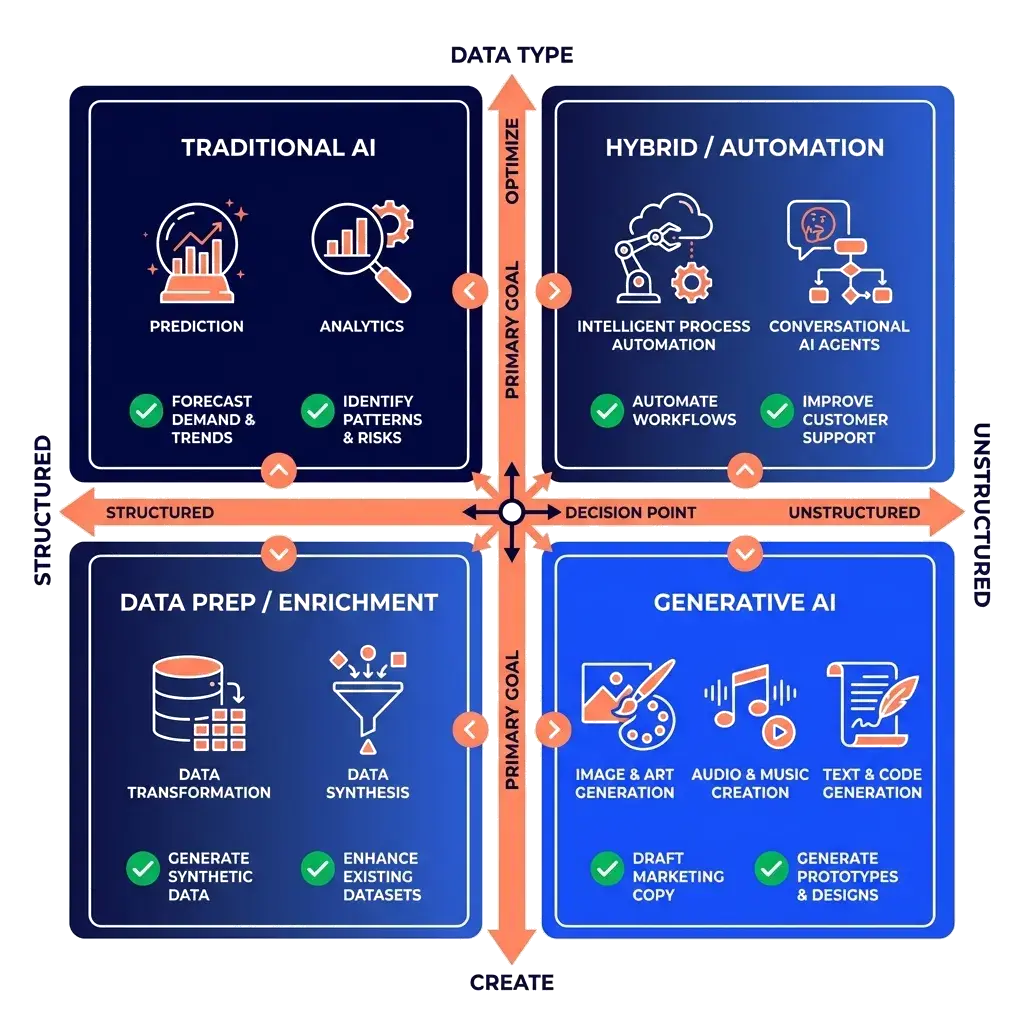
Before the specific terms, a baseline. When people say "AI" in a business context today, they're usually talking about one of three things:
- Machine Learning (ML): Systems that learn patterns from data and make predictions or decisions. Think: Netflix recommendations or fraud detection.
- Generative AI: Systems that create new content — text, images, code — based on patterns learned from training data. Think: ChatGPT, image generators, AI coding assistants.
- AI Agents: Systems that can take actions autonomously to achieve goals. Think: an AI that not only answers customer questions but also processes refunds or schedules appointments.
Most modern AI solutions combine elements of all three. Now the specific terms.
Part 1: Core AI Concepts

Large Language Model (LLM)
What it means
An AI system trained on massive amounts of text data that can understand and generate human-like language. LLMs power chatbots, writing assistants and most modern AI applications.
Why it matters
LLMs are the engine behind most generative AI applications. When evaluating AI solutions, knowing which LLM powers them (GPT-4, Claude, Llama) helps you assess capabilities and costs.
Real example
Your customer support team wants an AI chatbot. The vendor says it's powered by GPT-4. That tells you: high capability but higher per-interaction costs than alternatives like open-source models.
Training vs. Inference
What it means
Training is teaching an AI model by showing it examples — expensive, time-consuming, happens once or periodically. Inference is using that trained model to make predictions — cheaper, happens continuously.
Why it matters
Most businesses don't train AI from scratch (that's millions of dollars). You're paying for inference costs — every time someone uses your AI chatbot or gets a recommendation. Understanding this distinction helps you evaluate pricing models.
Real example
A vendor quotes you $50,000 for 'AI implementation'. Are they training a custom model from scratch (which might justify that cost) or just connecting you to an existing LLM via API (which probably shouldn't cost $50,000)? Knowing the difference prevents overpaying.
Prompt Engineering
What it means
The practice of carefully crafting the instructions (prompts) you give to an AI to get the best results. It's like learning exactly how to ask questions to get useful answers.
Why it matters
The difference between mediocre AI and amazing AI is often just better prompts. Companies that invest in prompt engineering get dramatically better results from the same underlying technology their competitors use.
Real example
Your team implements an AI writing assistant. Version 1 with basic prompts produces generic content nobody uses. After prompt engineering refinement, the same AI produces content your team incorporates into client deliverables. Same technology, 10× better results.
Hallucination
What it means
When an AI generates information that sounds confident and plausible but is completely made up. LLMs don't 'know' when they don't know something — they generate text that seems right based on patterns.
Why it matters
This is the biggest risk factor when deploying customer-facing or decision-critical AI. You need strategies to catch and prevent hallucinations before they cause problems.
Real example
Your AI customer support bot confidently tells customers about a 'premium support plan' that doesn't exist. Now you have angry customers who were promised something you don't offer. Understanding hallucinations helps you build proper guardrails.
Fine-Tuning
What it means
Taking an existing pre-trained AI model and training it further on your specific data to make it better at your particular use case — like taking a general-purpose tool and customizing it for your exact needs.
Why it matters
Fine-tuning bridges the gap between generic AI and AI that understands your business. More expensive than off-the-shelf AI, but less expensive than training from scratch.
Real example
You're a legal firm implementing AI for contract review. A generic LLM understands general contract language but misses nuances specific to your practice area. Fine-tuning it on 10,000 of your previous contracts makes it understand your specific terminology, clause patterns and risk factors. The AI goes from 'somewhat helpful' to 'actually useful for junior associates.'
Part 2: Data & Training Terms

Training Data
What it means
The examples an AI learns from during training. For traditional ML, this might be historical transactions labelled 'fraud' or 'legitimate'. For LLMs, it's massive amounts of text from the internet, books and other sources.
Why it matters
AI can only be as good as its training data. If the data is biased, incomplete or outdated, the AI will be too. Asking about training data helps you assess quality and potential blind spots.
Real example
You're implementing AI for hiring candidate screening. If the training data only includes resumes of people who were hired in the past (who were mostly from similar backgrounds), the AI will perpetuate those patterns. Understanding training data helps you spot bias issues before they become legal problems.
Embeddings
What it means
A way of converting text, images or other data into numbers that AI can mathematically compare. Embeddings allow AI to understand that 'customer support' and 'help desk' are similar concepts even though they're different words.
Why it matters
Embeddings power search, recommendations and many AI features you use daily. They help AI handle your specific domain terminology — finding relevant documents even when users search with different words.
Real example
Your company has 20 years of technical documentation using specific internal terminology. An AI search tool using embeddings finds relevant documents even when users search with different words, because embeddings capture meaning, not just exact word matches.
Tokens
What it means
The units AI models use to process text. Roughly 1 token = 3–4 characters or 0.75 words. AI pricing and limits are usually measured in tokens.
Why it matters
When a vendor says their model has a '128,000 token context window' or charges '$0.01 per 1,000 tokens', you need to understand what that means for your use case and budget.
Real example
You want AI to summarize customer call transcripts. Average call: 5,000 words (~6,700 tokens). At $0.01 per 1,000 tokens, each summary costs ~$0.07. With 1,000 calls per month, that's $70/month in AI fees. Understanding tokens lets you project costs accurately.
Context Window
What it means
The amount of information an AI can 'remember' or consider at once. A 128,000 token context window means the AI can work with roughly 96,000 words simultaneously — like reading a short novel at once.
Why it matters
Context window determines what's possible. Small context windows mean the AI can only consider short conversations or documents. Large context windows enable analysis of entire codebases, long customer histories or comprehensive reports.
Real example
Your legal team wants AI to analyze 50-page contracts. A model with an 8,000 token context window can only see about 12 pages at a time — forcing analysis in chunks and potentially missing important connections. A 128,000 token model analyzes the entire contract at once.
Structured vs. Unstructured Data
What it means
Structured data lives in organized databases with clear categories (spreadsheets, SQL databases). Unstructured data is everything else — emails, documents, images, conversations, videos.
Why it matters
Traditional business intelligence works great with structured data. AI's superpower is making sense of unstructured data that previously required human analysis. This distinction helps you identify where AI delivers the most value.
Real example
Your sales team has a CRM database (structured: deals, contact info, revenue) and years of email conversations with prospects (unstructured: objections, questions, decision factors). Traditional analytics only taps the CRM. AI can analyze both, extracting insights from those emails to predict which deals close.
Part 3: Implementation & Architecture Terms

API (Application Programming Interface)
What it means
A way for different software systems to talk to each other. When you 'use AI via API', you're sending requests to an AI service and receiving responses without building the AI yourself.
Why it matters
Most businesses access AI through APIs rather than building and hosting models themselves. Understanding APIs helps you evaluate vendor lock-in, costs and integration complexity.
Real example
You want to add AI chat to your customer portal. Option A: Build and train your own AI (millions of dollars, 18 months). Option B: Integrate with OpenAI's API (weeks of integration work, pay per use). APIs make enterprise AI accessible.
RAG (Retrieval Augmented Generation)
What it means
A technique where AI searches through your specific documents or databases before generating a response — pulling in relevant current information instead of just relying on training data.
Why it matters
RAG solves the 'how do I get AI to know about my business?' problem without expensive fine-tuning. It's how you make ChatGPT understand your products, policies and procedures.
Real example
You implement an AI assistant for your support team. Without RAG, it only knows general information from its training. With RAG, when a customer asks about your return policy, the AI searches your current policy documents and generates an answer based on your actual, up-to-date policies. It's the difference between generic advice and business-specific guidance.
Model
What it means
The actual AI system that makes predictions or generates outputs. When people say 'GPT-4 model' or 'our custom model', they're referring to the specific AI that's been trained to do a task.
Why it matters
Different models have different capabilities, costs and requirements. Knowing which model powers a solution helps you assess whether it's appropriate for your use case.
Real example
A vendor demos an impressive AI feature. You ask what model powers it. They say 'GPT-4'. You now know: it's highly capable but will have ongoing API costs and requires internet connectivity. If they said 'a custom model we host', you'd have different questions about quality and model updates.
Deployment
What it means
Making an AI system available for actual use — by customers, employees or other systems. Deployment includes hosting, monitoring, scaling and maintaining the AI in production.
Why it matters
Building a proof-of-concept AI is one thing. Deploying it reliably at scale is another. Many AI projects succeed in testing but fail in deployment. Understanding deployment helps you ask the right questions about vendor capabilities.
Real example
Your team builds an AI prototype that works great analyzing 100 documents. Then you try to deploy it for 10,000 daily users processing 50,000 documents. Suddenly you're dealing with response times, server costs, API rate limits and reliability. Deployment is where AI prototypes meet business reality.
Edge AI vs. Cloud AI
What it means
Cloud AI runs on remote servers — you send data there, it processes it and sends back results. Edge AI runs locally on devices (phones, cameras, sensors) without sending data elsewhere.
Why it matters
Cloud AI is more powerful and easier to update. Edge AI is faster, works offline and keeps data private. The choice depends on your use case, especially in regulated industries or situations requiring real-time responses.
Real example
You're implementing AI for quality control in manufacturing. Cloud AI means sending product images to external servers (potential delays, internet dependency, data leaving your facility). Edge AI runs analysis directly on cameras in your facility (faster, works offline, data stays local). For regulated manufacturing, edge AI might be required.
Part 4: Performance & Evaluation Terms
Accuracy vs. Precision vs. Recall
What it means
Three ways to measure AI performance. Accuracy = how often is it right overall. Precision = when it says yes, how often is it correct. Recall = of all the actual yes cases, how many did it catch.
Why it matters
Vendors love quoting high accuracy numbers — but depending on your use case, you might care more about precision or recall. Understanding these terms prevents you from being impressed by irrelevant metrics.
Real example
You implement AI fraud detection. 99% accuracy sounds great — but if only 1% of transactions are actually fraud, a system that marks everything 'not fraud' also has 99% accuracy while catching zero fraud. You actually care about recall (catching most fraud) and precision (not flagging legitimate transactions).
Benchmark
What it means
A standardized test that measures AI performance on specific tasks. Benchmarks let you compare different AI models fairly — like comparing cars using standardized fuel efficiency tests.
Why it matters
When vendors claim their AI is 'better', ask 'better on which benchmarks?' This helps you distinguish marketing hype from measurable improvement and assess whether those improvements matter for your use case.
Real example
Two vendors pitch you AI coding assistants. Vendor A ranks higher on HumanEval (measures code generation). Vendor B scores lower on HumanEval but higher on debugging and code review tasks. Understanding benchmarks helps you pick based on what your developers actually need.
Bias
What it means
When AI systematically favors or disfavors certain groups or outcomes based on patterns in training data. Bias can be obvious (discriminating by race or gender) or subtle (favoring certain writing styles or decision patterns).
Why it matters
Biased AI creates legal liability, reputational damage and bad business outcomes. As a business leader, you're accountable for AI decisions even if you don't understand the technical details. Understanding bias helps you ask the right questions before deploying AI.
Real example
You implement AI for reviewing loan applications trained on historical approval data. If past lending practices had bias (even unintentional), the AI learns and amplifies those patterns. Suddenly you're facing regulatory scrutiny because your 'objective' AI is systematically disadvantaging certain applicant groups.
Part 5: Advanced Concepts
Agent
What it means
AI that can take actions autonomously to achieve goals — not just answer questions. Agents can use tools, make decisions and complete multi-step tasks without constant human guidance.
Why it matters
Agents represent the evolution from 'AI as assistant' to 'AI as coworker'. More powerful but also requiring more careful implementation and oversight.
Real example
Your basic AI chatbot can answer customer questions by looking up information. An AI agent can: understand a customer has an issue, search your knowledge base, determine the problem requires a refund, check if the refund is within policy limits, process the refund and send a confirmation — all without human intervention. Same conversation, vastly different capabilities.
Multimodal AI
What it means
AI that can work with multiple types of input and output — text, images, audio, video — rather than just one. These models understand connections between different media types.
Why it matters
Multimodal AI enables more sophisticated applications: analyzing product images and descriptions together, transcribing and summarizing video meetings, or generating images from text descriptions.
Real example
You're in e-commerce and want AI to categorize products. Text-only AI reads descriptions but misses visual details. Image-only AI sees the product but misses context. Multimodal AI looks at both image and description together, understanding that those hiking boots with 'waterproof membrane' in the description belong under outdoor gear and waterproof footwear.
Part 6: Operating AI in the Real World
The first five parts cover what AI is. This part covers what happens after launch — the unglamorous discipline that decides whether your AI still works in two years. Most of an AI system's long-term cost and risk lives here, in the world of MLOps and model operations.
MLOps (Machine Learning Operations)
What it means
The discipline of deploying, monitoring and maintaining AI models in production — the equivalent of DevOps, but for machine learning. It covers model serving, drift detection, retraining and safe rollback.
Why it matters
A model that wins a demo and a model that stays accurate for two years in production are different achievements. MLOps is the difference. Without it, AI quietly degrades as the real world drifts away from its training data — and no one notices until it's a problem.
Real example
You deploy a demand-forecasting model that's 90% accurate at launch. Six months later buying patterns have shifted and it's down to 70% — but nobody caught it because no one was watching. MLOps detects that drift and triggers a retrain before it costs you a bad quarter.
Vector Database
What it means
A database built to store and search embeddings — the numerical representations of meaning. Instead of matching exact keywords, it finds the items that are closest in meaning.
Why it matters
Vector databases are the engine under RAG and AI search. When a vendor says their AI 'knows your documents', a vector database is usually how. Understanding it helps you assess how an AI actually retrieves your data.
Real example
Your support AI needs to answer from 5,000 help articles. Those articles are turned into embeddings and stored in a vector database. When a customer asks a question, the system pulls the 3 most relevant articles by meaning — not keyword — and feeds them to the LLM. That's RAG in practice.
Guardrails
What it means
The rules, filters and checks placed around an AI to keep it from doing or saying things it shouldn't — blocking unsafe outputs, staying on-topic and refusing requests outside its remit.
Why it matters
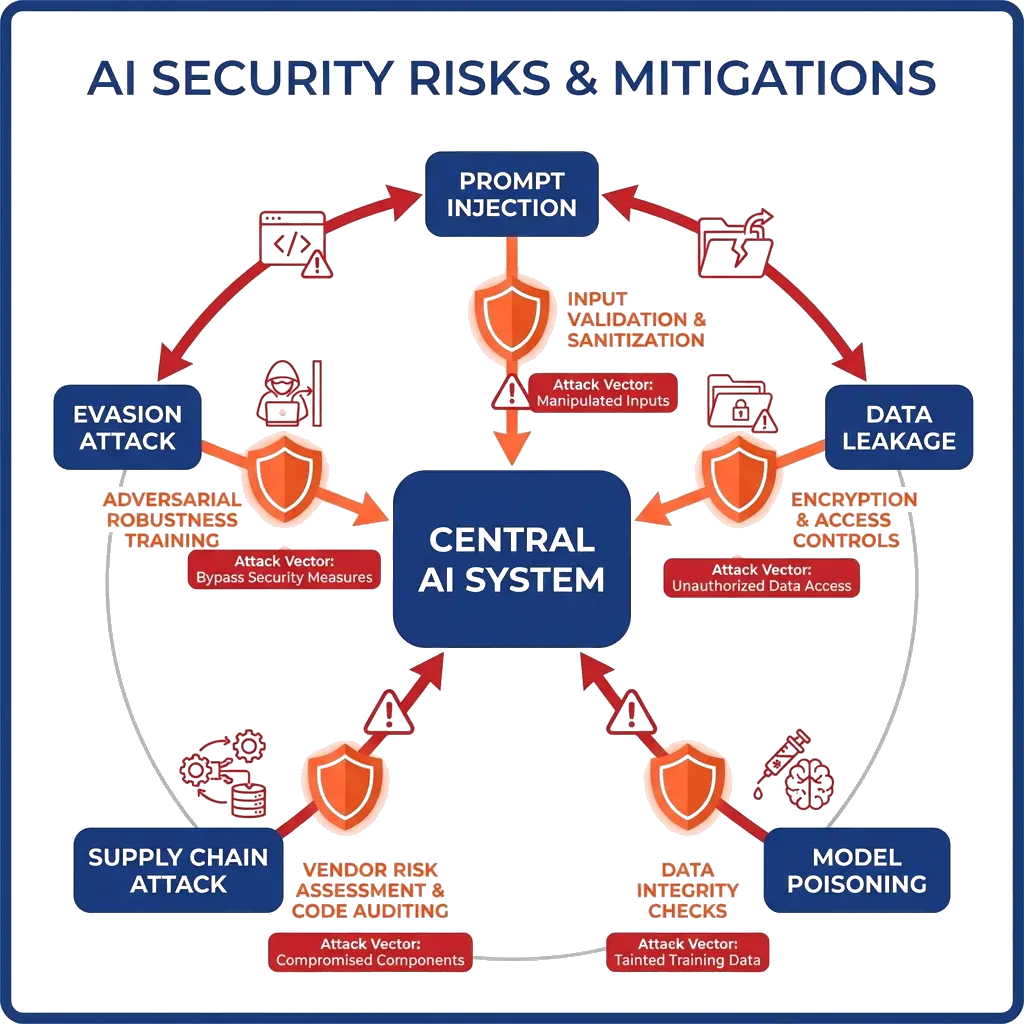
Guardrails are how you deploy customer-facing AI without lying awake at night. They're the practical answer to hallucination, off-brand responses and people trying to talk your AI into trouble.
Real example
Your assistant should answer product questions — not give medical or legal advice, not quote prices it invented, not be argued into rude replies. Guardrails enforce those boundaries: a refund bot that can only refund within policy, a chatbot that declines to speculate beyond your documents.
Human-in-the-Loop (HITL)
What it means
A design where a person reviews, approves or corrects the AI's output before it takes effect — keeping humans in control of consequential decisions rather than fully automating them.
Why it matters
For high-stakes decisions, full automation is a liability. Human-in-the-loop gives you AI's speed with human accountability — and every correction becomes training signal that makes the AI better over time.
Real example
An AI drafts insurance claim decisions, but a human adjuster approves anything above $5,000 or anything the model flags as uncertain. You get the throughput of automation on the easy 80% and human judgment on the risky 20%.
Part 7: Control, Models & Governance
The final five terms are about staying in control of the AI you deploy — picking the right model for the job, tuning how it behaves, embedding the right team and being able to defend its decisions. If you're weighing how much of this to build in-house versus partner on, our breakdown of AI implementation cost and our AI solutions practice are good next reads.
Temperature
What it means
A setting that controls how predictable or creative an AI's output is. Low temperature = focused, consistent, repeatable. High temperature = varied, creative, less predictable.
Why it matters
It's a small dial with big consequences. The wrong temperature makes a factual AI sound creative (dangerous) or a creative AI sound robotic (useless). Knowing it exists helps you diagnose 'why does our AI keep going off-script?'
Real example
For an AI that extracts data from invoices you want temperature near zero — same input, same output, every time. For an AI brainstorming marketing taglines you want it high — variety is the point. Same model, opposite settings.
Reasoning Models
What it means
A newer class of models that 'think' through a problem in steps before answering — spending extra compute to work through logic, math and multi-step tasks instead of replying instantly.
Why it matters
Reasoning models are markedly better at complex analysis but cost more and respond slower per query. Knowing the trade-off lets you match the model to the task instead of overpaying for simple jobs.
Real example
Summarizing an email doesn't need a reasoning model — a fast, cheap one is fine. Auditing a 40-page contract for conflicting clauses does. Using a reasoning model for the email wastes money; using a basic model for the contract misses things.
Open-Source vs. Proprietary Models
What it means
Proprietary models (GPT-4, Claude) are accessed through a vendor's API — powerful and maintained for you, but you don't control them. Open-source models (Llama, Mistral) can be self-hosted — full control and data privacy, but you run the infrastructure.
Why it matters
This is one of the biggest architecture decisions in an AI project. It drives your cost structure, data privacy, vendor lock-in and compliance posture all at once.
Real example
A healthcare provider can't send patient data to an external API, so they self-host an open-source model inside their own environment. A marketing startup with no such constraint just calls a proprietary API and ships in a week. Same goal, opposite right answer.
AI Governance & Compliance
What it means
The policies, documentation and controls that make your AI use auditable, accountable and legally defensible — who approved a model, what data it used, and how its decisions can be explained and contested.
Why it matters
As AI regulation tightens (the EU AI Act, sector rules in finance and healthcare), governance stops being optional. It's also how you manage the liability you already carry for automated decisions.
Real example
A bank using AI for credit decisions must show regulators which factors drove a denial, prove the model was tested for bias and produce an audit trail. Governance is the difference between 'our AI decided' and 'we can defend every decision our AI made.'
Forward Deployed AI Engineer (FDE)
What it means
A production engineer embedded directly inside a client's environment (repositories, data pipelines, legacy systems) to build, harden and ship production AI systems rather than delivering recommendations from the outside.
Why it matters
Most AI pilots fail on integration, data security and real-world edge cases rather than foundation model capabilities. Forward deployed engineers work directly inside your stack to bridge the gap between a prototype and a hardened production system.
Real example
Instead of hiring a traditional consultancy to produce a strategy report, an enterprise brings in a [forward deployed engineering team](/forward-deployed-ai-engineers) to wire an LLM into their ERP with custom eval harnesses and hand over the working system to internal developers in 60 days.
How to Use This Glossary Effectively
Now that you understand these 29 core terms, here's how to apply this knowledge:
In vendor conversations: When a vendor uses technical jargon, ask them to explain in business terms. If they say their model has "98% accuracy", ask: accuracy at what? on which benchmark? precision or recall?
In internal discussions: Use correct terminology so your technical team knows you understand the fundamentals. Ask about hallucination prevention when teams propose customer-facing AI. Question whether you need fine-tuning or if RAG would suffice.
In strategic planning: Identify whether your data is structured or unstructured to determine where AI delivers most value. Consider bias implications before deploying AI in sensitive domains. Evaluate whether you need an agent or just a chatbot based on the actions required — we break that distinction down in AI agents vs. chatbots vs. automation.
The goal isn't to become a data scientist. The goal is to have informed conversations about AI investment, ask the right questions and spot when someone is overselling or underdelivering.
Want to discuss AI implementation for your specific business context?
Let's build your AI roadmap together. Schedule a free consultation to discuss your specific situation — no commitment, we respond within 24 hours.
The companies winning with AI aren't necessarily the ones with the biggest technical teams. They're the ones whose business leaders understand enough to ask the right questions, make informed decisions and hold their teams and vendors accountable.
Irfan Malik is the CEO and Founder of ibute, with 20 years of experience helping businesses leverage custom software and AI solutions to scale efficiently. He specializes in making complex technology accessible and actionable for business leaders.
Frequently Asked Questions
Why do business leaders need to know these technical terms?
What is the difference between Generative AI and standard Machine Learning?
How can I prevent AI hallucinations in my business applications?
Is fine-tuning always necessary for business AI?
What is the context window and why does it matter for costs?
What is MLOps and why does it matter after an AI project goes live?
Should we use an open-source model or a proprietary API?
Need a clear path forward?
Get a custom AI roadmap — tailored to your stack, timeline and budget.
Talk to an Expert →