If you're evaluating AI for your business right now, you've probably noticed something frustrating: everyone talks about "AI" like it's one thing. But when you dig deeper you realize there are fundamentally different types of AI — and they solve completely different problems.
The two categories causing the most confusion right now are generative AI (think ChatGPT, DALL-E, content creation tools) and traditional AI (think predictive analytics, recommendation engines, fraud detection). Both are powerful. Both deliver ROI. But they work in completely different ways — and your business probably needs to invest in one before the other.
This guide cuts through the hype and helps you make a practical decision based on your actual business needs, budget and technical readiness.
What Actually Differentiates These Two Types of AI?
Before you can decide which to invest in, you need to understand what each type actually does. The difference isn't just technical jargon — it determines whether the AI will work for your use case or burn your budget with zero results.
Traditional AI: Pattern Recognition and Prediction
Traditional AI (also called narrow AI or discriminative AI) excels at analyzing existing data to find patterns, make predictions and automate rule-based decisions. It learns from historical data and applies those learnings to new situations.
Real-world examples: Netflix recommending shows based on your watch history, credit card companies detecting fraudulent transactions in real time, manufacturing systems predicting equipment failures before they happen, email providers filtering spam, and healthcare platforms predicting patient readmission risk.
Traditional AI is exceptional at tasks with clear inputs, measurable outputs and historical data to learn from. It doesn't create anything new — it recognizes patterns and makes decisions based on what it has seen before.
Generative AI: Content Creation and Synthesis
Generative AI creates new content from scratch. It can write text, generate images, compose code or produce synthetic data that looks and feels like human-created work. Rather than just analyzing patterns, it generates novel outputs.
Real-world examples: customer support chatbots that write personalized responses (not just pick from templates), marketing teams generating product descriptions at scale, developers using AI coding assistants to write and debug code, design teams creating initial mockups instantly, and sales teams drafting personalized outreach emails based on prospect research.
Generative AI shines when you need to produce content, automate communication or generate variations quickly. It doesn't just recognize what exists — it creates what doesn't exist yet.
The Decision Matrix: When to Use Which
Most businesses don't need to choose one forever. The question is: which should you invest in first?
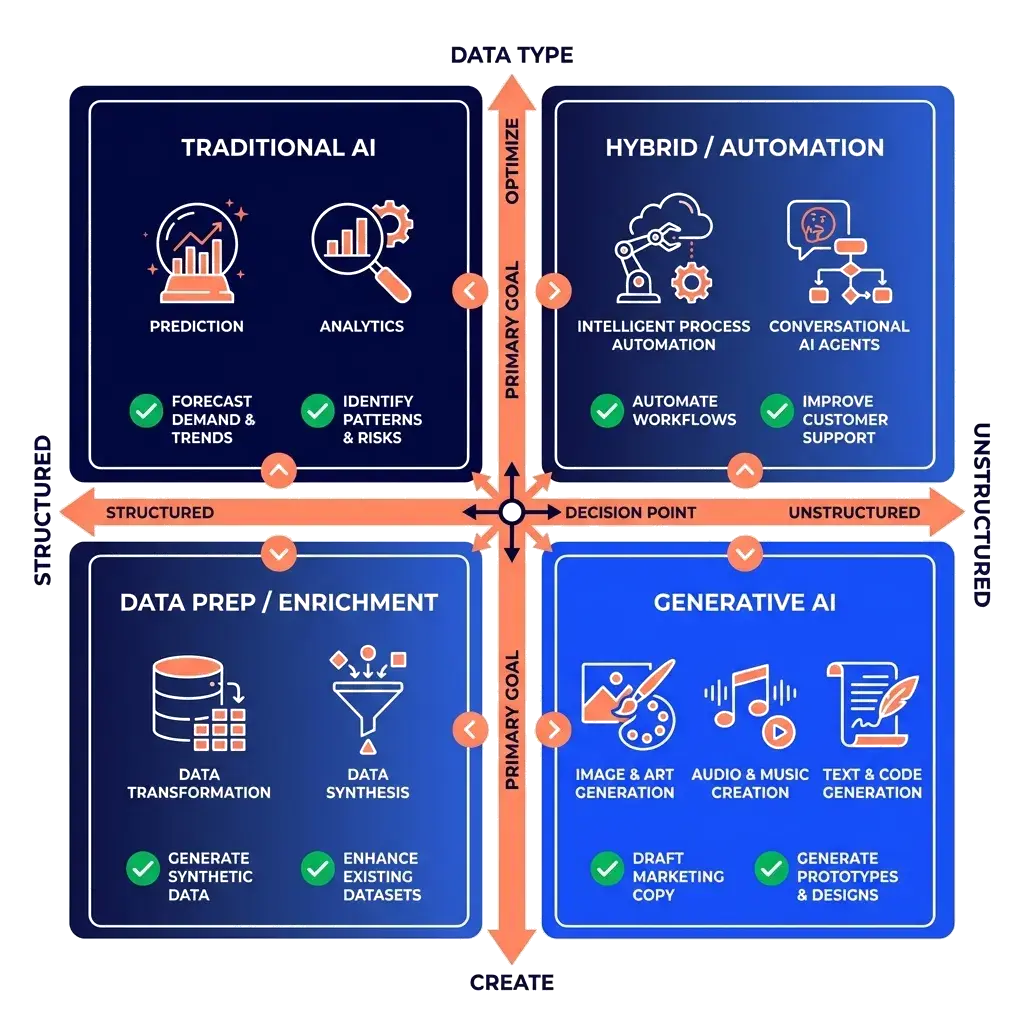
Choose Traditional AI first if you: have structured historical data (transaction records, customer behavior data, operational metrics or sensor readings), need consistent and explainable decisions (particularly in regulated industries like finance and healthcare where you must justify why a prediction was made), want to optimize existing processes rather than create new content, and have clear numerical success metrics (reduce fraud by 20%, predict churn with 85% accuracy, decrease downtime by 30%).
Example scenario: A logistics company wants to optimize delivery routes and predict maintenance needs. They have years of GPS data, vehicle performance logs and delivery records. Traditional AI is the clear choice — it will analyze patterns and make predictions that save fuel costs and prevent breakdowns.
Choose Generative AI first if you: need to scale content creation (customer support responses, marketing copy, product descriptions, technical documentation), want to improve customer interactions with intelligent conversational AI, have knowledge scattered across documents and systems (generative AI with RAG can surface it instantly), or need to prototype and brainstorm quickly.
Example scenario: A SaaS company receives 500 support tickets daily — most are variations of the same 20 questions. Generative AI can analyze incoming tickets, search the knowledge base and draft personalized responses for agents to review and send. Support team efficiency doubles without hiring.
The Cost Reality: What You're Actually Paying For
AI investment isn't just the initial build cost. You need to factor in data preparation, training, deployment, monitoring and ongoing optimization. The total cost of ownership differs significantly between these two approaches.
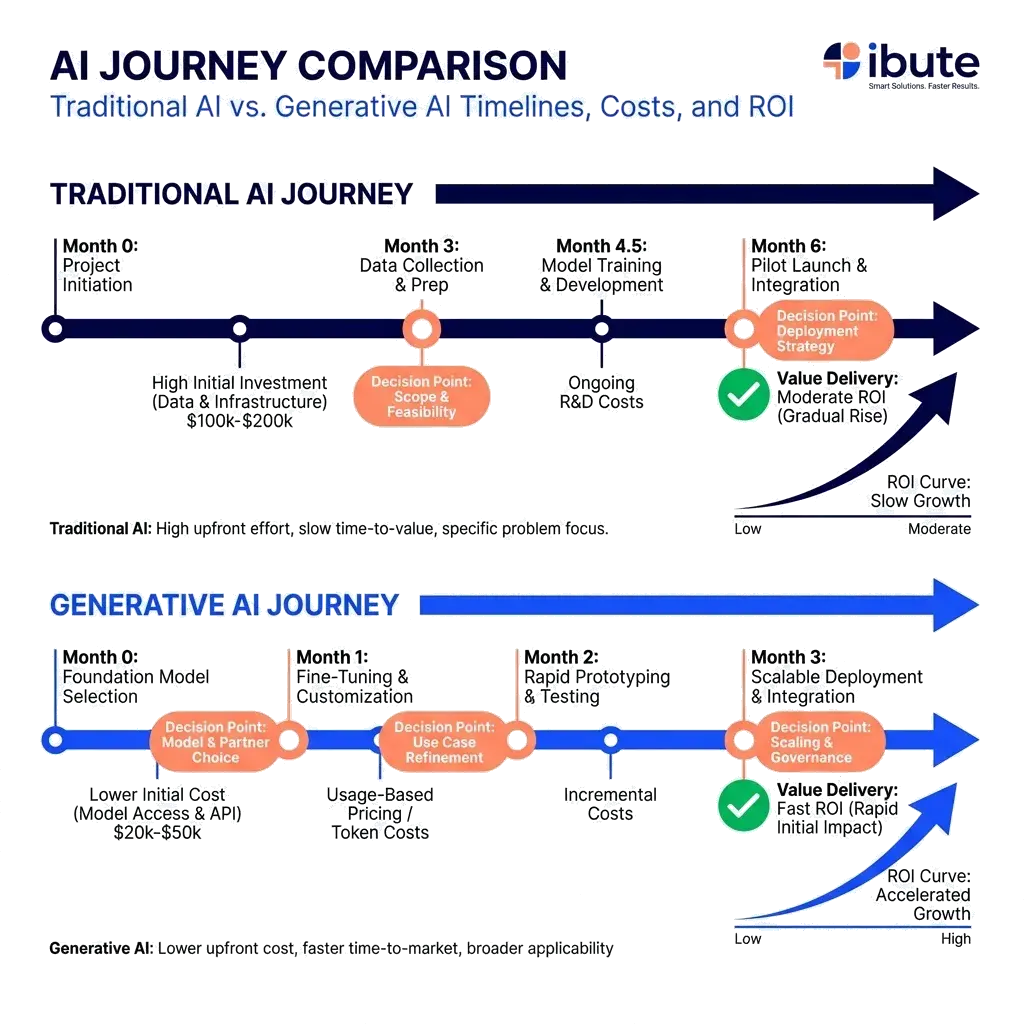
Traditional AI cost breakdown: upfront costs include data collection and cleaning (often 60–70% of initial project time), model selection and training, and infrastructure setup. Ongoing costs include model retraining, performance monitoring and infrastructure maintenance. Typical investment: $25,000–$150,000+ initial. Time to value: 3–6 months.
Generative AI cost breakdown: upfront costs include API integration, prompt engineering, fine-tuning if needed, and UI development. Ongoing costs include API usage fees (per token), prompt optimization and content quality monitoring. Typical investment: $15,000–$80,000+ initial. Time to value: 1–3 months (faster due to pre-trained models).
The Hybrid Reality
Here's what most companies discover six months into their AI journey: you probably need both — just not at the same time. The smartest approach is to sequence your investments based on which delivers faster ROI for your specific situation.
Common hybrid scenarios by industry: e-commerce starts with traditional AI for recommendations (immediate revenue impact), then adds generative AI for product descriptions later. Healthcare starts with traditional AI for readmission prediction (clear outcomes), then adds generative AI for documentation assistance. Finance starts with traditional AI for risk assessment (security), then adds generative AI for reporting and client communication.
Real Implementation: How One Climate Tech Startup Used Both Strategically
When Iris Technologies approached us, they were building a carbon footprint tracking platform. They needed to both calculate emissions accurately (traditional AI) and help users understand the data (generative AI).
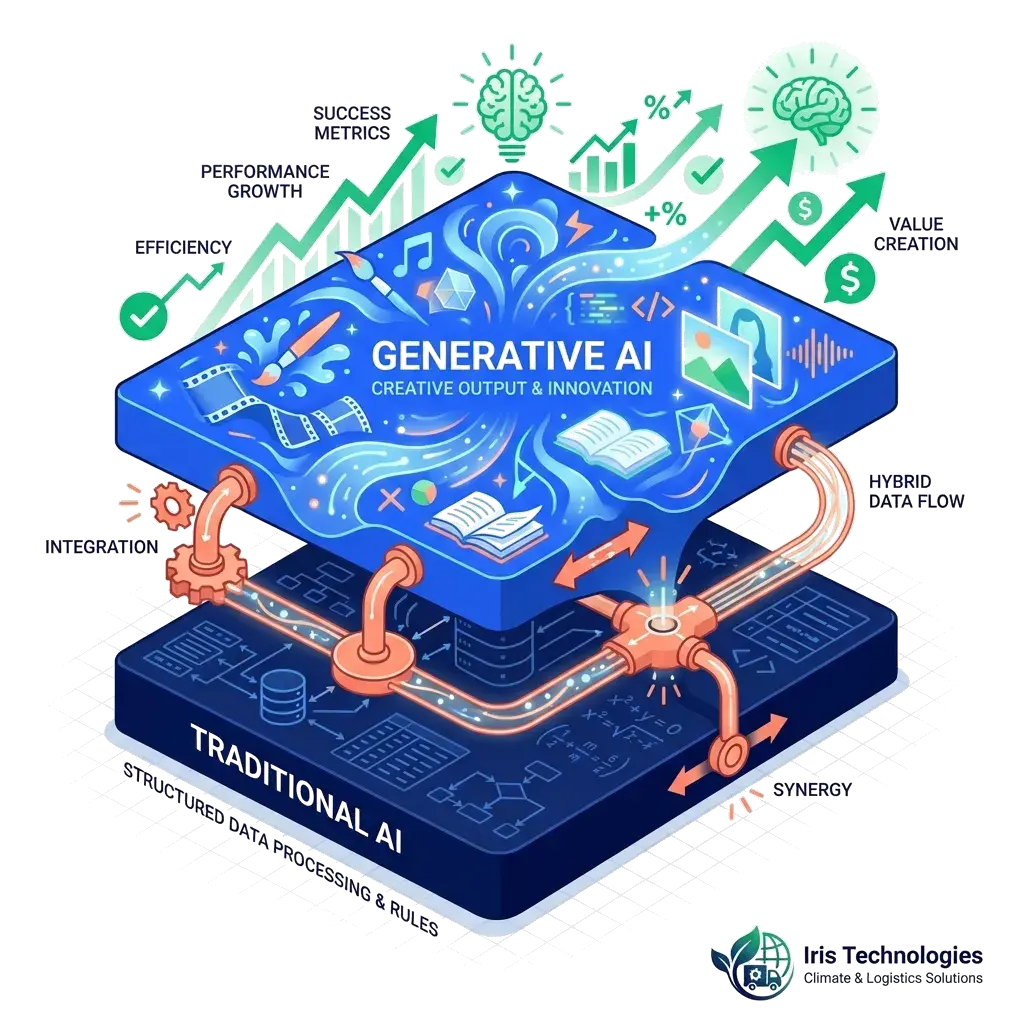
We started with Traditional ML to classify transport modes and predict emissions. Once that foundation was solid, we added Generative AI to power a chatbot that explained the results to users in plain language. The calculated data gave the "truth" — and the generative AI gave the "experience." Neither alone would have delivered what Iris needed.
The Four Questions That Determine Your Starting Point
Still not sure which to prioritize? Answer these four questions honestly.
1. What's your most expensive bottleneck right now? If it's manual data analysis → Traditional. If it's content creation or customer communication → Generative.
2. What data do you actually have? Structured historical data (transactions, sensors, records) → Traditional. Unstructured docs, emails, knowledge bases → Generative.
3. What does success look like in 90 days? Measurable metric improvement (reduce X by Y%) → Traditional. Scaling output or improving customer experience → Generative.
4. What's your risk tolerance? Traditional AI is more predictable but takes longer and requires more data. Generative AI is faster to deploy but requires quality control to catch hallucinations and maintain consistency.
Not sure which AI type fits your situation?
Let's map your specific business challenges to the right AI approach. Free consultation — we'll tell you honestly which technology makes sense for your use case and budget, and which to invest in first.
Irfan Malik is the CEO and Founder of ibute, with 20 years of experience helping businesses leverage custom software and AI solutions to scale efficiently. He specializes in making complex technology accessible and actionable for business leaders.
Frequently Asked Questions
Is Traditional AI 'fake' AI?
Can I implement both at the same time?
Which one is more expensive to maintain?
Do I need a data science team for these?
Need a clear path forward?
Get a custom AI roadmap — tailored to your stack, timeline and budget.
Talk to an Expert →