If you've been following AI developments lately, you've probably seen the term "agentic AI" everywhere. Major tech companies are launching agent platforms, analysts are calling it the next evolution of business automation and your competitors are likely asking the same question you are: "What exactly is agentic AI and should my business care?"
The Short Answer: Agentic AI represents a fundamental shift from tools that respond to commands to systems that can observe, reason and act autonomously to achieve business goals.
But that definition doesn't help you decide if it's right for your business, what it costs or where to start. This guide cuts through the hype to give you the practical understanding you need to make informed decisions about agentic AI for your specific industry.
What Makes Agentic AI Different (And Why It Matters)
Let's start with what agentic AI is NOT: it's not a chatbot that answers customer questions, not workflow automation that moves data between systems, and not a dashboard that shows you insights.
Agentic AI is a system that can: Observe its environment and gather relevant information. Reason about what actions will best achieve defined goals. Act autonomously without waiting for human approval. Learn from outcomes to improve future decisions.
Think of it this way: a chatbot is like a receptionist who answers questions when asked. Workflow automation is like a conveyor belt that moves items along a fixed path. Agentic AI is like a skilled employee who understands the goal, evaluates options, makes decisions, takes action and learns from the results.
The Key Difference: Autonomy + Goal Orientation
Traditional AI tools are reactive — they wait for you to ask a question or trigger a workflow.
Agentic AI is proactive — you set the goal and the system figures out how to achieve it, adapting to changing conditions along the way.
Example: Traditional automation says "When inventory hits 50 units, send me an alert." Agentic AI says "Maintain optimal inventory levels while minimizing carrying costs" — and the agent monitors demand patterns, supplier lead times, seasonal trends and automatically adjusts reorder quantities and timing. It doesn't just alert you to a problem. It solves the problem within the parameters you've defined.
E-commerce & Retail: Beyond Basic Automation
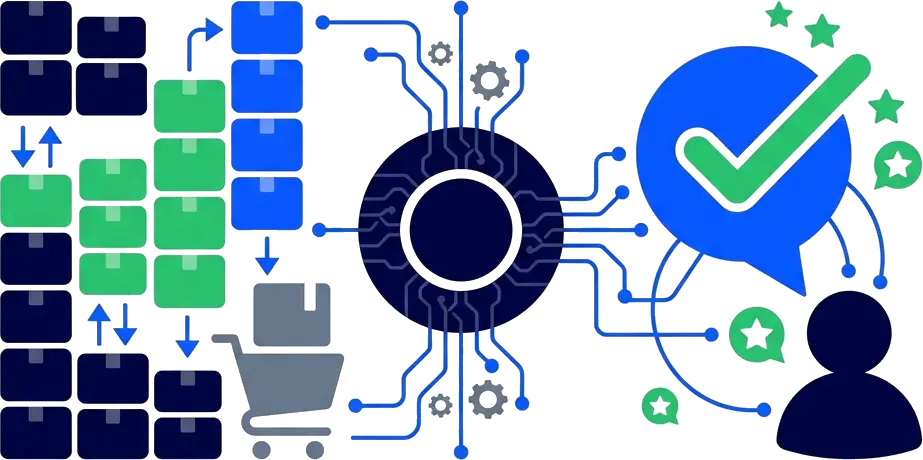
Intelligent Inventory Management. E-commerce businesses struggle with the inventory balancing act — too much stock ties up capital, too little means lost sales. An inventory management agent continuously monitors real-time sales velocity, seasonal trends, supplier lead times, competitor pricing and marketing campaign schedules. It autonomously adjusts reorder points and quantities, shifts inventory between warehouses and flags slow-moving items for promotions before they become dead stock. Expected impact: 30–40% reduction in carrying costs, 50–60% fewer stockouts, 15–25% improvement in cash flow.
Dynamic Customer Service Escalation. A customer service agent doesn't just answer questions — it manages the entire support experience. It evaluates complexity and urgency, resolves straightforward issues instantly, identifies high-value customers requiring human empathy and proactively reaches out to customers experiencing issues before they complain. Expected impact: 65–75% of inquiries resolved without human intervention, response time from hours to seconds for routine issues, 25–35% improvement in customer satisfaction scores.
Healthcare: Solving Operational Bottlenecks
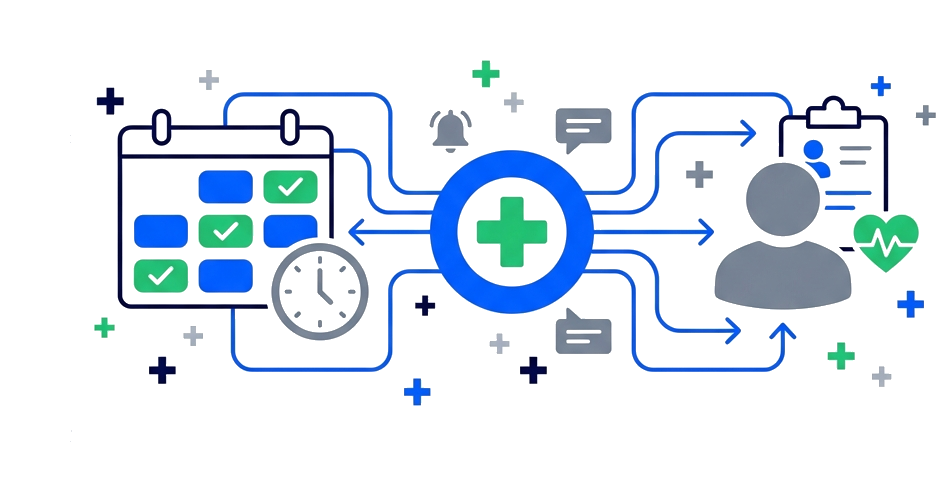
Intelligent Appointment Management. Medical practices lose thousands monthly to no-shows, last-minute cancellations and inefficient scheduling. A scheduling agent analyzes historical no-show patterns, dynamically adjusts scheduling density, automatically fills cancellations, optimizes schedule for provider efficiency and sends personalized reminders via patient-preferred channels. Expected impact: 40–50% reduction in no-show rates, 20–30% increase in daily patient volume, providers spend 90+ more minutes per day on patient care.
Clinical Documentation Automation. Physicians spend 1–2 hours per day on documentation — time that could be spent with patients. A clinical documentation agent listens to patient encounters and generates structured clinical notes in real time, extracts key information, cross-references patient history to flag potential drug interactions and suggests appropriate billing codes. Expected impact: 60–70% reduction in documentation time, 15–25% improvement in coding accuracy and reimbursement.
Professional Services: Transforming Knowledge Work

Contract Review & Analysis (Legal). A contract analysis agent reviews contracts against a firm's knowledge base of problematic clauses, identifies non-standard terms and hidden liabilities, compares terms to industry benchmarks and suggests alternative language based on the firm's preferred positions. Expected impact: 70–80% reduction in initial contract review time, 100% consistency in identifying standard risk factors, ability to take on 30–40% more clients without hiring.
Research & Due Diligence Automation (Consulting). A research agent gathers relevant information from internal knowledge bases and industry sources, identifies patterns and anomalies, generates preliminary analysis for human review and creates draft reports following the firm's templates. Expected impact: 50–60% reduction in research and data gathering time, project delivery timelines compressed by 30–40%.
Financial Services: Risk, Compliance and Efficiency

Fraud Detection & Prevention. A fraud detection agent continuously monitors transaction patterns, builds behavioral profiles for each customer, identifies anomalies while minimizing false positives and autonomously blocks high-risk transactions. Expected impact: 40–60% reduction in fraud losses, 70–80% fewer false positives (better customer experience), real-time protection instead of post-transaction detection.
Loan Processing & Credit Decisions. A loan processing agent gathers and verifies documentation, cross-references applicant information, assesses risk using traditional and alternative data sources and routes edge cases to human underwriters with detailed analysis. Expected impact: loan decisions in minutes instead of days, 90% straight-through processing for standard applications, 30–40% reduction in default rates.
How to Evaluate If Agentic AI Is Right for Your Business
Not every business needs agentic AI right now. You're a strong candidate if: you have repetitive decision-making processes that follow consistent logic, speed matters and delays cost you money or customers, you have 6+ months of historical data, the ROI is clear and calculable, and you're comfortable with "good enough" decisions (95% accuracy with immediate action often beats 99% accuracy with delays).
You should wait if: your processes are poorly defined or inconsistent, you lack historical data, errors would be catastrophic (medical diagnoses, safety-critical systems), your business is rapidly changing (the agent would need constant retraining), or you need perfect explainability for every decision due to regulatory requirements.
Implementation Considerations
Timeline expectations: Discovery & Planning (2–4 weeks), Development & Training (8–16 weeks), Testing & Refinement (4–8 weeks), Full Deployment (2–4 weeks). Total: 4–8 months from start to full production.
Investment range: Entry-level single-function agents run $30K–$60K with well-defined problems and 2–3 system integrations. Mid-tier multi-function agents with complex decision-making across multiple data sources run $60K–$150K. Enterprise systems with mission-critical operations, advanced security and compliance requirements run $150K+.
Common Concerns About Agentic AI
"What if the AI makes a wrong decision?" Every agentic AI system should have guardrails: decision boundaries you define, confidence thresholds for human review, audit trails, emergency stop functionality and regular human oversight. The goal isn't perfect decisions — it's better overall outcomes.
"Will this replace my team?" No. Agentic AI handles repetitive, data-intensive decision making so your team can focus on strategic planning, complex situations requiring human judgment, relationship building and creative problem solving. Most businesses using agentic AI are growing, not downsizing.
"How do I maintain control?" Through goal definition, performance monitoring dashboards, regular review, human override capability and feedback loops where the system learns from corrections you make.
Getting Started: A Practical Roadmap
The path to your first agentic AI system has five steps. First, identify your highest-impact use case — find the one process that consumes the most time or money, has clear success metrics and would deliver ROI within 6–12 months. Second, assess your data readiness — do you have 6+ months of historical data that's accessible and reasonably clean? Third, define success clearly with specific, measurable targets. Fourth, start with a pilot — test with 10–20% of transactions, one product line or one geographic region. Fifth, plan for change management — your team needs to understand what the agent will do and how it affects their roles.
The Bottom Line: Agentic AI isn't science fiction or distant future technology. It's being deployed right now by businesses across industries, delivering measurable ROI and competitive advantages. The question isn't whether agentic AI will transform your industry — it's whether you'll be an early adopter who gains the advantage or a late follower playing catch-up.
Ready to explore agentic AI for your business?
Let's discuss which agentic AI use case fits your industry and operations. Schedule a free consultation — we'll assess your readiness and build a realistic roadmap together.
Irfan Malik is the CEO and Founder of ibute, with 20 years of experience helping businesses leverage custom software and AI solutions to scale efficiently. He specializes in making complex technology accessible and actionable for business leaders.
Frequently Asked Questions
What's the difference between agentic AI and regular chatbots?
How long does it take to implement agentic AI?
Can agentic AI work with my existing systems?
Is agentic AI safe? What if it makes wrong decisions?
How much does agentic AI implementation cost?
Will agentic AI replace my employees?
Need a clear path forward?
Get a custom AI roadmap — tailored to your stack, timeline and budget.
Talk to an Expert →