You've identified the use case. You've got buy-in from the team. Now you need a number to put in the budget.
The problem: ask three different vendors and you'll get three very different answers. One says $15,000. Another says $150,000. A third says "it depends." None of them explain why.
This guide gives you the framework to understand what drives AI agent costs and what a realistic budget looks like for your specific situation.
The Short Answer
Custom AI agent development in 2026 typically costs between $20,000 and $200,000+ for the initial build, depending on complexity. Most mid-market deployments fall in the $35,000–$120,000 range. Ongoing operational costs run $400–$5,000+ per month depending on volume and model usage.
That range is wide for a reason — the variance comes from five factors we'll break down in detail. By the end of this guide, you'll know where your project sits in that range before speaking to a single vendor.
The most expensive mistake: Paying for an enterprise-grade agent when a focused Tier 1 or Tier 2 solution would solve your problem. Over-engineering is the #1 driver of wasted AI budget.
The Three Cost Tiers
Tier 1: Focused Single-Task Agent ($20,000–$40,000)
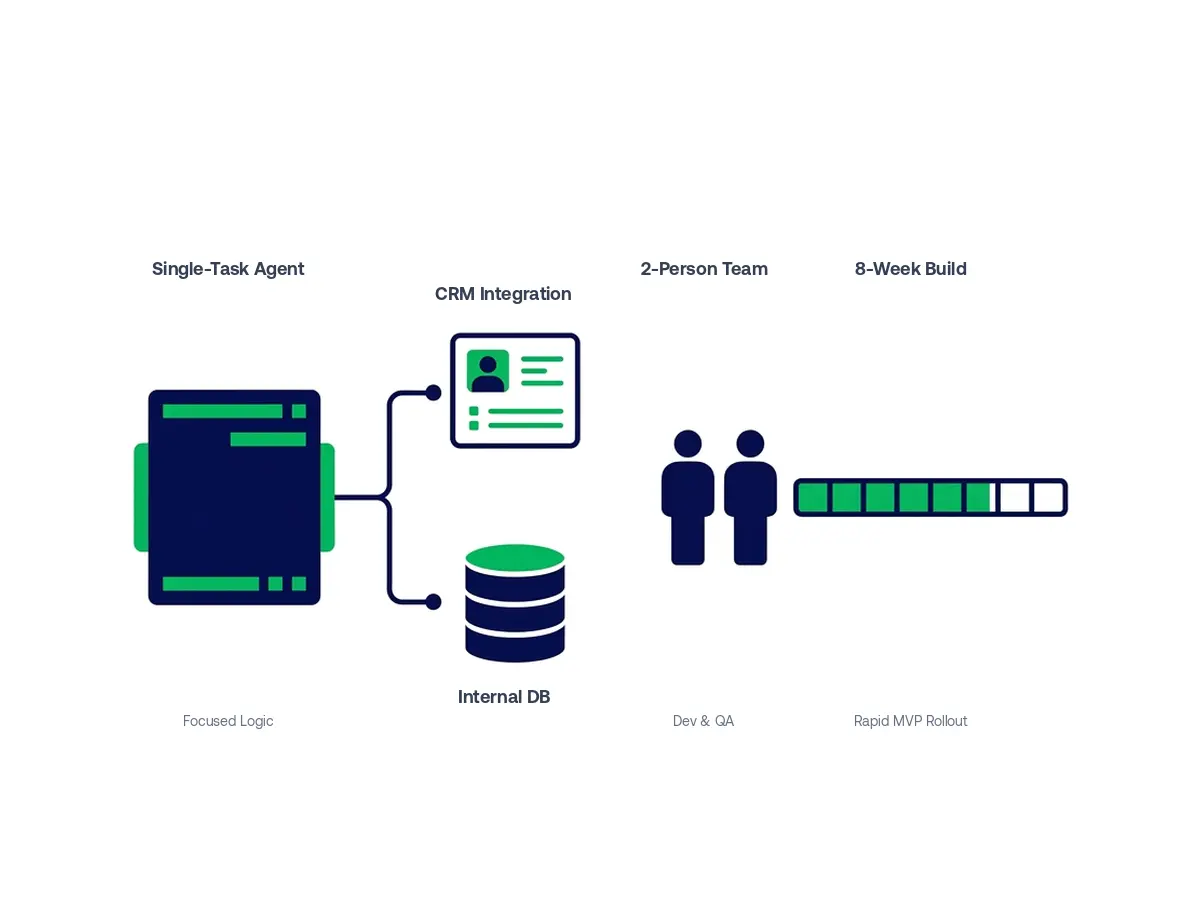
A Tier 1 agent handles one well-defined job end-to-end. It integrates with 2–4 systems, has straightforward decision logic, and operates within a narrow scope.
What's included: Discovery and requirements (15–20 hrs), system integrations and API connections (25–40 hrs), agent logic and prompt engineering (20–30 hrs), testing and QA (15–20 hrs), deployment and monitoring setup (10 hrs), documentation and team training (8 hrs).
Real example: A lead qualification agent that monitors a CRM for new inbound leads, researches the company via web search, scores fit against defined criteria, and sends a personalised first email. Build cost: $22,000. Deployed in 8 weeks.
Who it's right for: SMBs tackling one high-volume, repetitive process. Strong ROI because the scope is tight and the timeline is short.
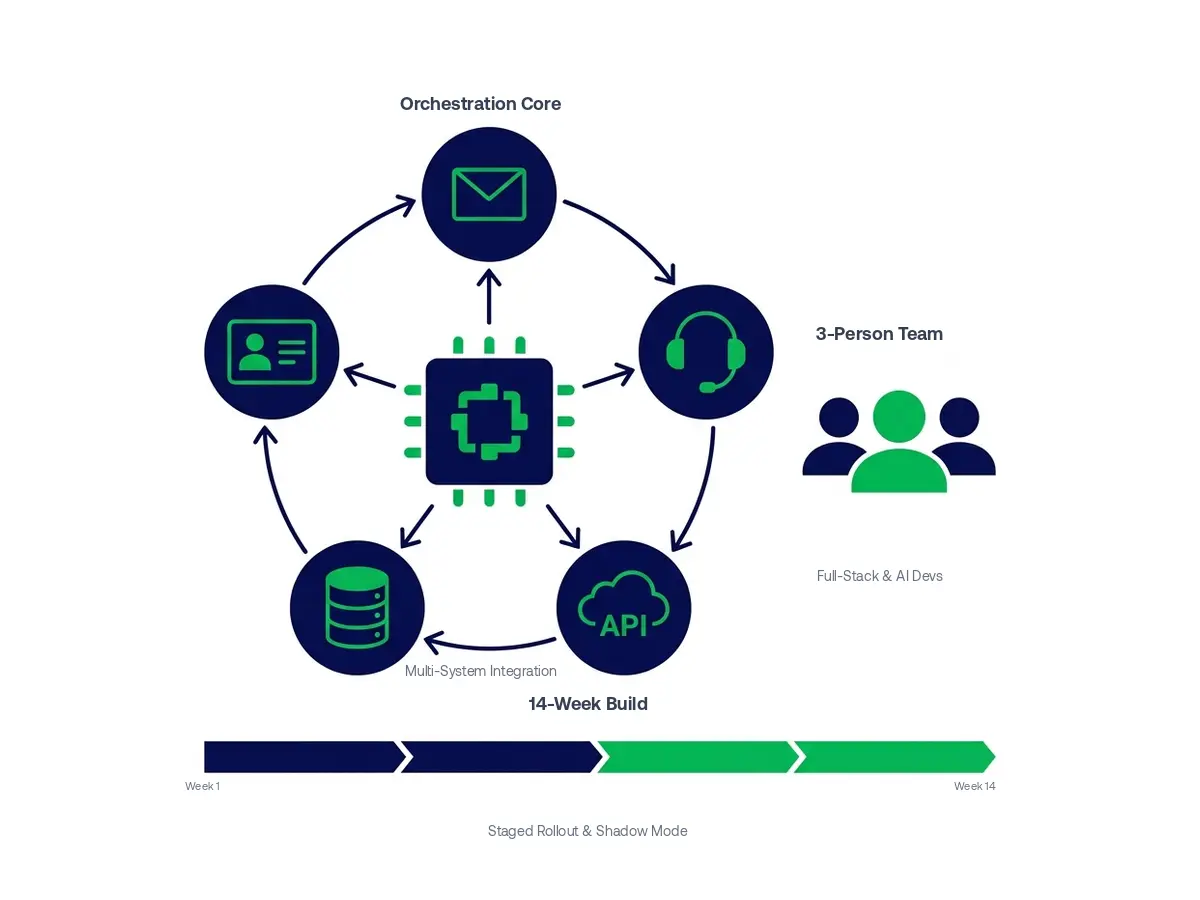
Tier 2: Multi-Step Orchestration Agent ($35,000–$75,000)
A Tier 2 agent manages a complex workflow with multiple decision points, integrates with 5–10 systems, and handles significant variation in inputs and outputs.
What's included: Extended discovery (25–35 hrs), complex workflow mapping and logic design, multiple system integrations, custom tooling for edge cases, robust error handling and retry logic, shadow mode testing period, staged rollout plan, and 30-day post-launch support.
Real example: A customer support agent that handles first-line tickets across email, chat, and helpdesk, retrieves order/account data, resolves 70% autonomously, and hands off complex cases to humans with full context. Build cost: $52,000. Deployed in 14 weeks.
Who it's right for: Growing businesses with complex workflows where the efficiency gain justifies a longer build. Often delivers the highest ROI in absolute dollars.
Tier 3: Enterprise AI Agent System ($75,000–$200,000+)
A Tier 3 build involves multiple interconnected agents, custom model fine-tuning, enterprise security and compliance requirements, and deep integration with complex internal systems.
What's included: Full architecture design, data engineering for proprietary datasets, custom model training or fine-tuning, advanced RAG infrastructure, enterprise security review, SSO and access control, audit logging, disaster recovery, and typically 6–12 months of dedicated support.
Real example: A financial services firm's loan processing agent system — extracting data from application documents, checking creditworthiness against internal criteria, routing for compliance review, and generating assessments. Build cost: $140,000. 6-month build.
Who it's right for: Enterprise businesses where the agent handles regulated processes, sensitive data, or complex multi-step decisions where errors are costly.
The Five Factors That Move Your Cost
Understanding these five variables lets you estimate where your project falls within a tier — and potentially identify ways to reduce cost before you build.
1. Integration Complexity
Every system your agent needs to talk to adds development time. A straightforward REST API integration takes 4–8 hours. A legacy system with no API that needs a custom connector takes 20–40 hours. A real-time bi-directional sync with guaranteed delivery takes even longer.
Cost driver: Number of integrations × their complexity. Map your integrations before getting quotes — it directly affects the price.
2. Data Readiness
This is the most underestimated cost driver. If your data is clean, structured, and accessible via API, the agent can start working with it immediately. If your data is incomplete, inconsistent, or trapped in a system without an API, you have a data preparation problem before you have an AI problem.
Typical data prep costs: Basic cleaning and formatting: $2,000–$8,000. Building a structured knowledge base from unstructured documents: $5,000–$20,000. Data migration from legacy systems: $10,000–$40,000.
Ask yourself this question: If I asked a new employee to do this task on day one, using only the data the agent will have access to, could they do it accurately? If the answer is no, your data isn't ready — and your AI won't be either.
3. Compliance and Security Requirements
Standard business agents require basic security — authentication, encrypted data in transit, access controls. Enterprise agents in regulated industries require significantly more: SOC 2 compliance, HIPAA controls, PCI DSS requirements, data residency, audit logging, and formal security reviews.
Cost addition: Standard security: included in base cost. Compliance-grade security: add $8,000–$25,000.
4. Volume and Scale
The same agent logic serving 100 tasks per day versus 10,000 tasks per day has very different infrastructure requirements. Higher volume needs more robust error handling, queue management, rate limiting, and monitoring.
Cost addition: Low-volume (<500 tasks/day): minimal. High-volume (5,000+ tasks/day): add $5,000–$20,000 in infrastructure and optimisation work.
5. Who You Hire
This is the biggest lever. The same project at three different vendors:
- Freelancer/small team: $20,000–$40,000. Lower cost, but you're managing the project, quality varies, and support after delivery is limited.
- Specialist AI agency (like ibute): $25,000–$150,000+. End-to-end ownership from scoping through deployment, often utilizing embedded forward deployed AI engineers inside your codebase to ensure seamless integration and handover without open-ended consultancy drift.
- Big consultancy: $80,000–$200,000+. Same technology, much higher overhead, enterprise sales process, you pay for the brand.
Ongoing Costs to Budget For
The build is a one-time cost. These recur monthly.
LLM API costs: Every time your agent calls an LLM (Claude, GPT-5, Gemini, etc.), you pay per token. For most business agents, this is $100–$800 per month. High-volume agents can hit $2,000–$5,000/month. Prompt optimisation and model selection can reduce this by 40–60%.
Infrastructure/hosting: $50–$300/month on cloud hosting (AWS, GCP, Azure). Simple agents on the lower end, high-availability production systems on the upper end.
Maintenance retainer: Plan for 15–25% of build cost annually. AI agents need prompt updates as business rules change, re-testing when model providers update or deprecate model versions, security patches, and iterative improvements based on real usage data. The higher end applies to agents in regulated industries or those with frequent workflow changes.
Total monthly ongoing for a typical Tier 2 agent: $500–$1,200/month.
The ROI Calculation
Every AI agent investment should clear a simple hurdle: payback within 18 months.
The formula:
- Annual saving (hours saved × hourly rate + avoided errors + revenue impact)
- Divide by total investment (build + first year ongoing costs)
- If result is > 1.0, you're ROI-positive in year one
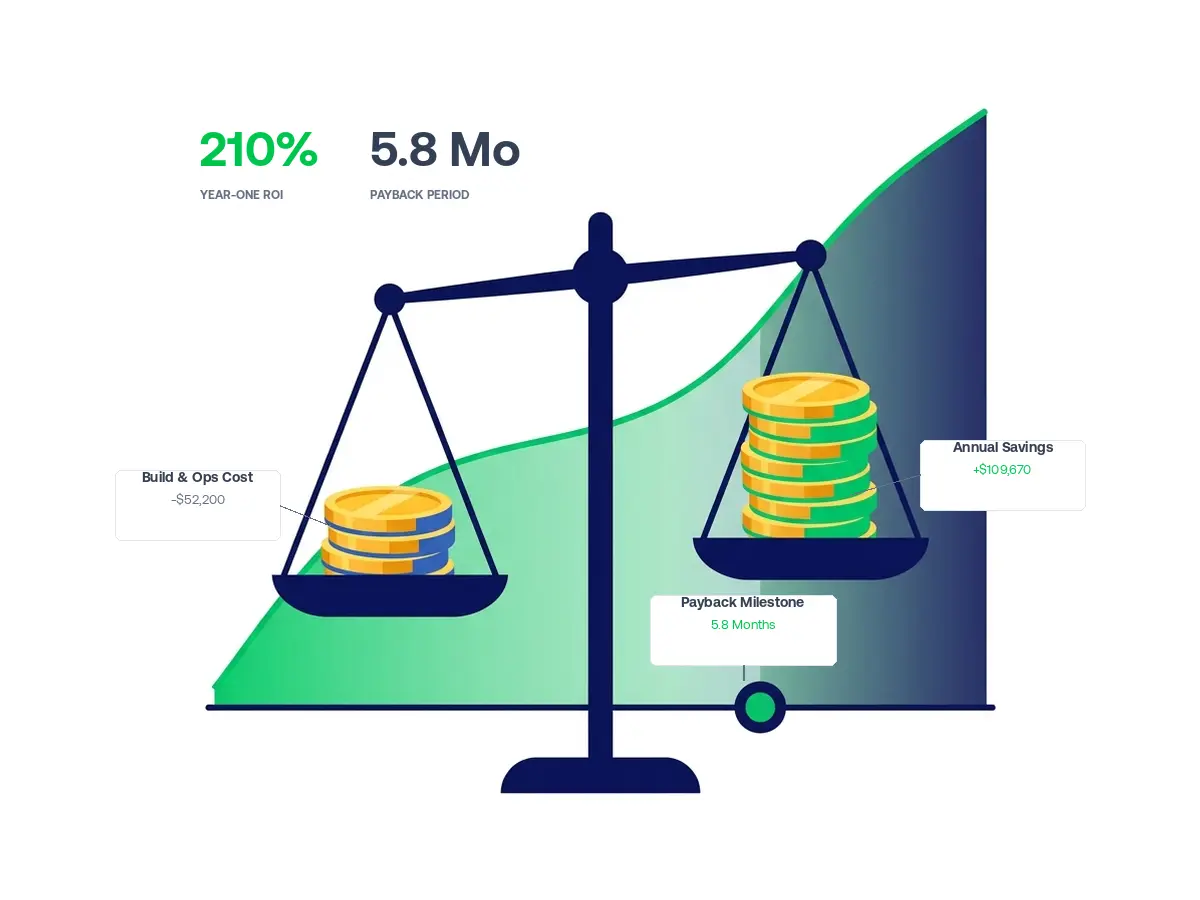
Example: Customer support agent. Build cost $45,000. Monthly ongoing $600. Year-one total investment: $52,200.
The agent handles 68% of 2,400 monthly tickets. Each ticket previously took 12 minutes of agent time at $28/hour fully loaded. Monthly saving: 2,400 × 0.68 × (12/60) × $28 = $9,139. Annual saving: $109,670.
Year-one ROI: $109,670 ÷ $52,200 = 210%. Payback period: under 6 months.
Run this calculation for your use case before building. If the numbers don't work, either the use case is wrong, the scope is too large, or both.
How to Get an Accurate Quote
Three things to have ready before talking to any vendor:
A written description of the current workflow. Step by step, what does a human do today? Where does the data come from? What decisions are made? What systems are touched?
Volume numbers. How many times does this task happen per day/week/month? This determines both the ROI case and the technical requirements.
A data audit. Can you give a vendor API access to your CRM/ERP/database? Is the data clean? What's missing? The honest answer to these questions determines how much of your budget goes to pre-build data work versus the agent itself.
With these three things prepared, a reputable vendor can give you a reasonably accurate fixed-price quote within a week — not a "T&M, we'll figure it out as we go" estimate.
Get a transparent, fixed-price quote for your AI agent
Share your use case with us and we'll give you a detailed cost breakdown within 48 hours — not a range, an actual number. No commitment required.
Irfan Malik is the CEO and Founder of ibute, with 20 years of experience helping businesses leverage custom software and AI solutions to scale efficiently. He specializes in making complex technology accessible and actionable for business leaders.
Frequently Asked Questions
Why do AI agent quotes vary so much?
Is there a cheaper way to get started?
What ongoing costs should I budget for?
Does the AI agent cost include the software licences it connects to?
Need a clear path forward?
Get a custom AI roadmap — tailored to your stack, timeline and budget.
Talk to an Expert →