Here's the short version, because you're busy: buy off-the-shelf AI for the problems your competitors also have, and build custom AI for the problems that are uniquely yours. Everything else in this article is how to tell which is which and how to avoid the expensive mistake of getting it backwards.
The "custom vs off-the-shelf" decision is usually framed as a budget question: custom is expensive, off-the-shelf is cheap, pick based on what you can afford. After years of building AI solutions for companies of every size, I'll tell you plainly: that framing costs people more money than it saves. The real question isn't price. It's fit. And fit is what decides whether the cheaper-looking option is actually the cheaper option.
First, define the terms, because vendors won't
Off-the-shelf AI is anything you use roughly as-is: a SaaS AI product, an "AI insights" feature baked into a tool you already pay for, a generic chatbot or a foundation-model API used straight out of the box. Think ChatGPT Enterprise, your CRM's new AI panel, an off-the-shelf support bot.
Custom AI is built around your data, your workflow and your rules. It might be a RAG system over your documents, a fine-tuned model or an agent wired into your internal systems.
One clarification that kills a lot of bad assumptions: custom does not mean from scratch. Almost nobody trains a foundation model anymore. That's a multi-million-dollar exercise with no business case for 99% of companies. Custom in 2026 means custom around existing models. When someone quotes you a large fee to "build a custom AI model," your first question should be whether they're training from zero (rarely justified) or integrating an existing model (which shouldn't carry that price tag).
The decision framework
When a client asks me "should we buy or build," I don't start with budget. I ask four questions.
1. Is this problem unique to you or shared by your whole industry?
Transcribing calls, translating text, drafting first-pass content, answering FAQs: every company has these. They're commodities, and the market has already built excellent, cheap tools for them. If your competitor down the street has the exact same problem, someone has already productized the solution. Buy it.
But if the problem is shaped by something only your business has (your pricing logic, your compliance rules, the specific way parts move through your factory), no off-the-shelf vendor is going to build for an audience of one. That's where custom earns its keep.
2. Is your data the advantage, or is the model the advantage?
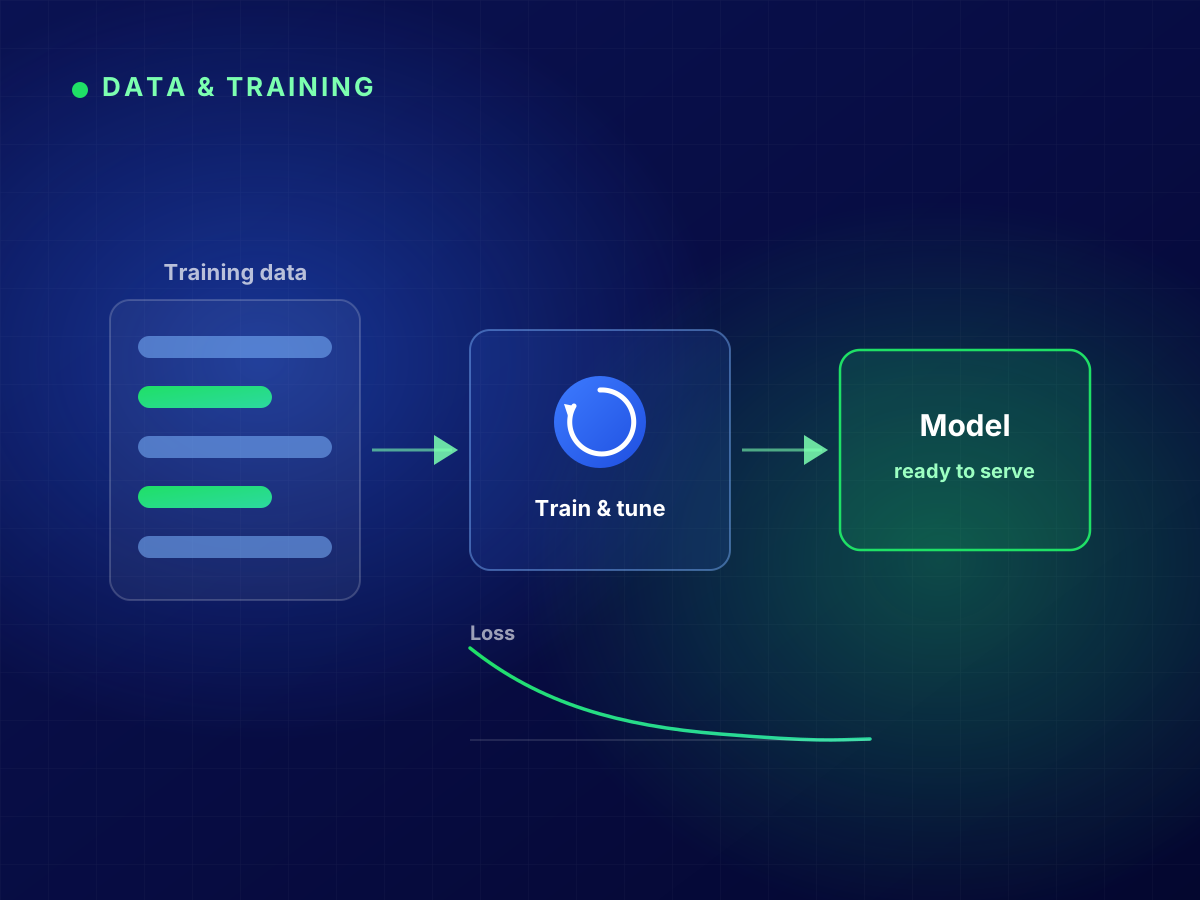
If the value comes from a capable general model doing a general task, buy the model's access and move on. If the value comes from your proprietary data (twenty years of support tickets, your transaction history, your domain knowledge), then the model is just the engine and your data is the moat. Off-the-shelf tools can't use your moat without you handing it to them.
3. How tightly does it need to fit your workflow?
A tool that lives in its own tab and gets copy-pasted from is fine for some jobs. But the highest-value AI disappears into the workflow people already use. It acts inside your systems, not beside them. Deep workflow fit almost always means custom engineering, because off-the-shelf integrations stop exactly where the vendor's roadmap stops.
4. What's the cost of it being 80% right?
This is the one people skip, and it's the most important.
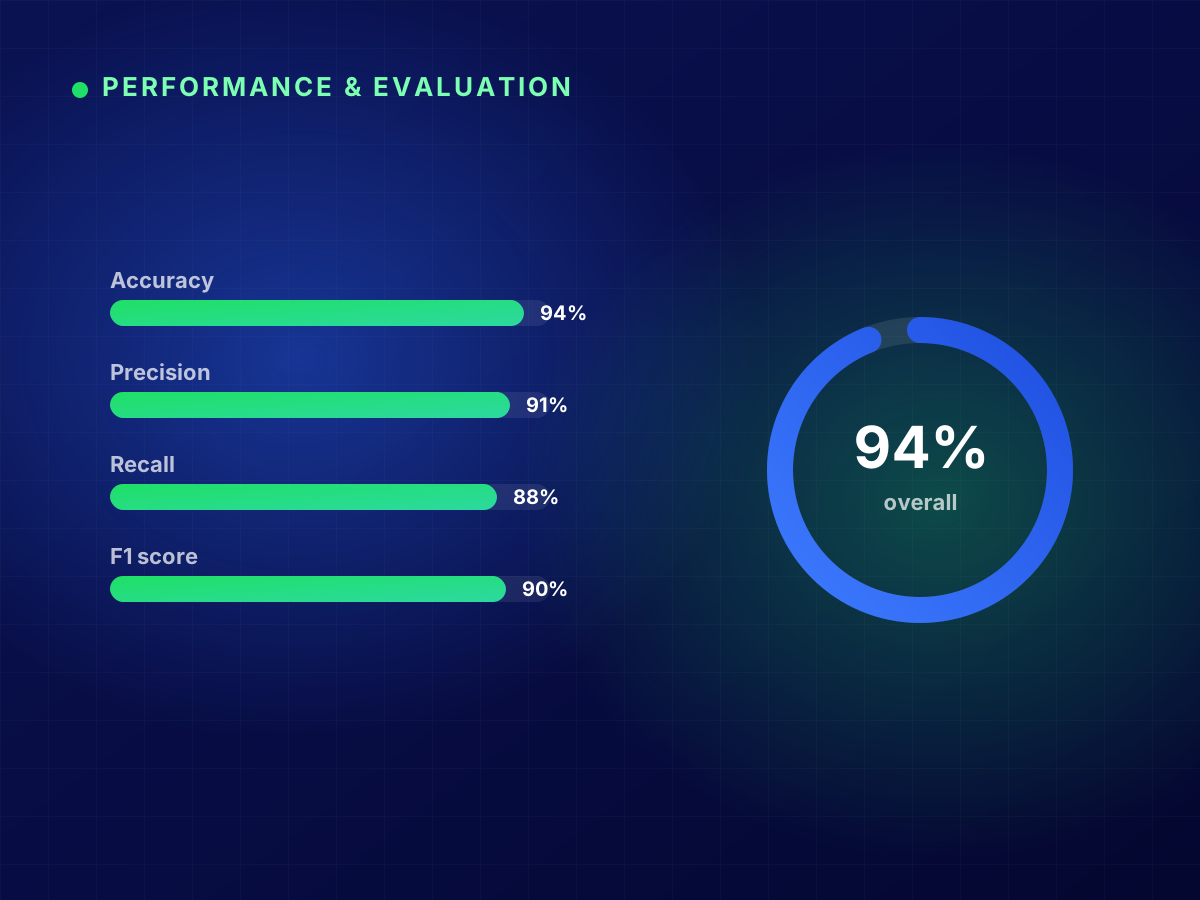
Off-the-shelf AI is very good at getting you to 80%. The question is whether the last 20% is the part that actually mattered. For drafting a marketing email, 80% is a gift. For deciding which loans to approve or how much inventory to hold, the missing 20% is the entire reason you wanted AI.
If 80% is genuinely good enough, off-the-shelf wins on speed and cost. If the last 20% is where the money (or the risk) lives, that 20% is your custom build.
When off-the-shelf genuinely wins
I build custom software for a living, and I will still tell you to buy off-the-shelf when it's the right call, because recommending a build you don't need is how you lose trust.
Off-the-shelf is the right answer when:
- The problem is a commodity: transcription, translation, generic chat, first-draft content, meeting summaries.
- You need value this month, not this quarter. A good SaaS tool is live this afternoon.
- You're still validating. Don't commission a custom build for a use case you haven't proven has value yet.
- The scale is small. At low volume, per-seat pricing is cheaper than owning anything.
If a $50-a-month tool does 90% of what you need, building custom is ego, not strategy. Buy the tool.
When custom wins
Custom is the right answer when:
- Your data is the advantage. The value lives in information only you have.
- Workflow fit is the point. It has to act inside your systems, not next to them.
- Off-the-shelf plateaus at 80% and the last 20% is the whole job.
- Your data legally can't leave. In regulated sectors, sending data to an external API isn't an option, so you build and host it yourself. (We go deep on this in secure AI implementation.)
- Unit economics flip at scale. Past a certain volume, owning the system beats paying per call forever.
The hidden costs nobody quotes
Both sides have a bill the sales deck leaves out.
Off-the-shelf's hidden costs: the integration tax (connecting a generic tool to your real systems is routinely underestimated), pricing that scales against your success, vendor lock-in, the hard 80% ceiling and, quietly, your data improving the vendor's product for everyone, including your competitors.
Custom's hidden cost is the one most people get wrong. It isn't the build. It's the operation.
The expensive part of custom AI isn't building it. It's keeping it good. A model that's 90% accurate at launch drifts as the world changes. Keeping it accurate is the ongoing discipline of MLOps (monitoring, retraining, maintenance), and it's where most of the real lifetime cost lives.
If a custom AI quote doesn't include the cost of running and maintaining the thing after launch, it's not a real quote. We break the full picture down in our guide to AI implementation cost.
Most real systems are a hybrid
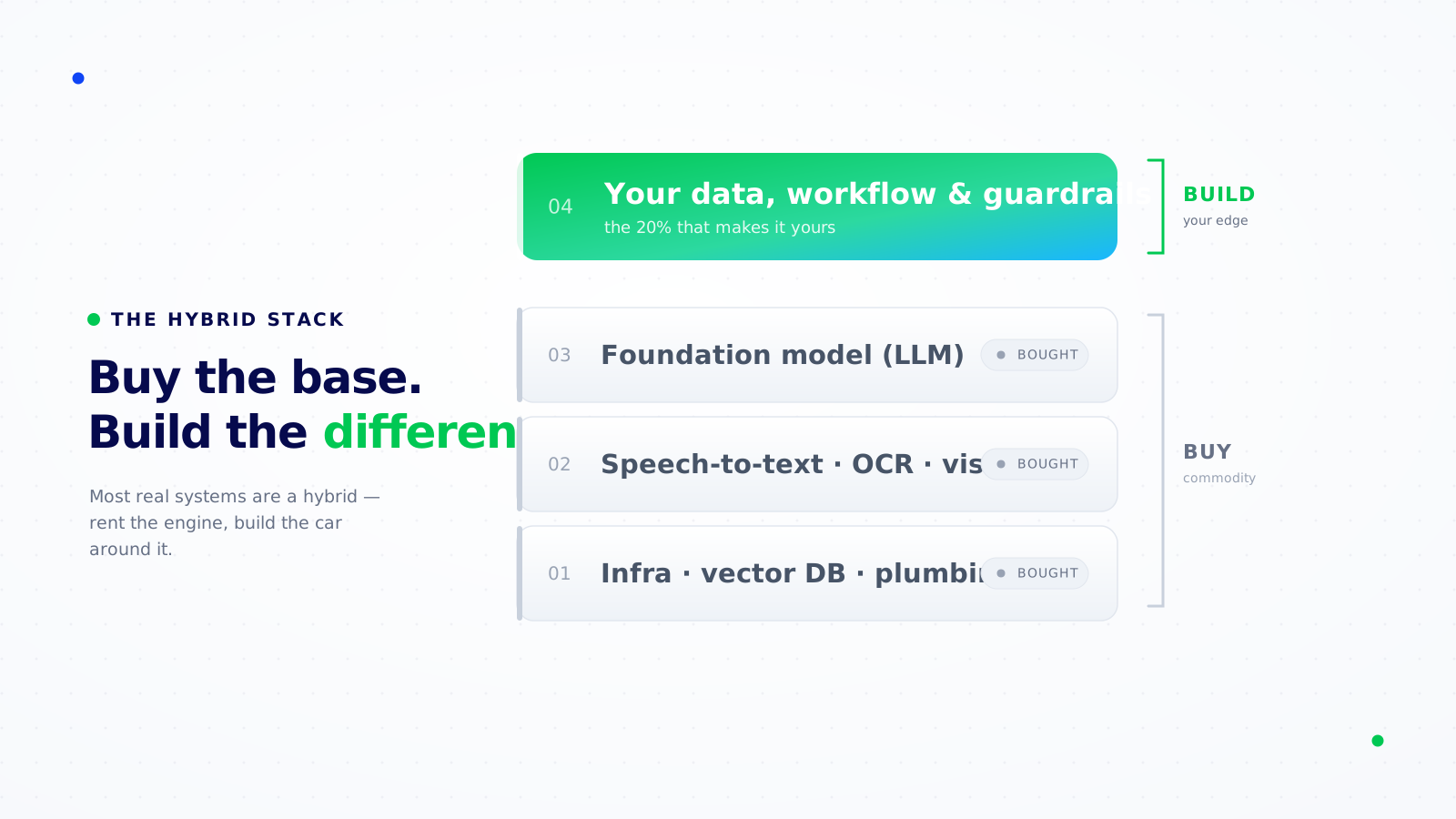
Here's what the binary framing misses: in practice, the answer is almost never "all custom" or "all bought." It's a stack.
You buy the commodity layer (the foundation model, the transcription, the generic plumbing) and you build the thin, differentiated layer that's actually yours: the logic, the data integration, the workflow fit, the guardrails. You rent the engine and build the car around it.
A support system might use an off-the-shelf model (bought) with RAG over your own knowledge base (built), inside your own ticketing workflow (built), behind compliance guardrails (built). Most of the value is in the built parts, but you'd be foolish to train the engine yourself.
How we actually decide with clients
Our default is almost contrarian for a custom-software firm: start off-the-shelf wherever it's honestly good enough, and build only the parts that are uniquely yours. That keeps the custom investment small, focused and defensible, and it means by the time we build, we're building with evidence from a real tool, not assumptions from a slide.
You can see how that plays out in practice across our client work. None of those systems are "all custom." They're a sharp custom layer on top of bought commodity infrastructure, which is exactly where the economics work.
Not sure whether to buy or build for your use case?
Tell us the problem you're trying to solve. We'll tell you honestly where off-the-shelf is good enough and where a custom build actually pays for itself. No commitment. We respond within 24 hours.
The companies that win with AI aren't the ones that spent the most or the least. They're the ones that bought the commodity, built the difference and knew which was which.
Irfan Malik is the CEO and Founder of ibute, with 20 years of experience helping businesses leverage custom software and AI solutions to scale efficiently. He specializes in making complex technology accessible and actionable for business leaders.
Frequently Asked Questions
Is custom AI always more expensive than off-the-shelf?
Does 'custom AI' mean training our own model from scratch?
How do I know if off-the-shelf AI has hit its ceiling?
What's the biggest hidden cost of off-the-shelf AI?
Can we start with off-the-shelf and move to custom later?
Need a clear path forward?
Get a custom AI roadmap, tailored to your stack, timeline and budget.
Talk to an Expert →