Customer support is where AI agents deliver some of the most measurable ROI in business — and where poorly implemented AI does the most damage to customer relationships.
The 70% automation figure isn't marketing. It's achievable. But that number comes with an asterisk: the 70% you automate needs to be resolved correctly, quickly, and in a way that doesn't frustrate customers into cancelling. The "70%" is the ceiling for a well-designed agent. A poorly designed one automates 70% of tickets but loses the customer in 40% of those cases.
This guide covers both parts: how to get to 70% automation and how to keep your customers happy while you do it.
Why Customer Support is the Best First AI Agent Use Case
Before the architecture, the business case. Customer support wins as a first AI agent deployment for three reasons.
The data is already there. Every helpdesk contains thousands of solved tickets — real examples of customer problems with correct resolutions. This is the training and testing data your agent needs, already organised and searchable.
The ROI is immediate and measurable. Resolution time, escalation rate, and CSAT scores give you clear before/after numbers within weeks of deployment.
The scope is narrow enough to be reliable. Unlike a general-purpose assistant, a support agent has a defined domain (your product), defined tools (your helpdesk, your CRM, your knowledge base), and a defined success metric (issue resolved without escalation).
Industry benchmarks (2026): Published industry data puts the median enterprise deflection rate at around 40–42%, with top-quartile deployments reaching 58–65%. Leading e-commerce brands with well-optimised knowledge bases and clean data are hitting 70%+ on transactional queries. If your current automation rate is below 20%, there's an enormous opportunity waiting — and 40–50% is a realistic first-year target for most businesses.
The Architecture: What a Real Support Agent Looks Like
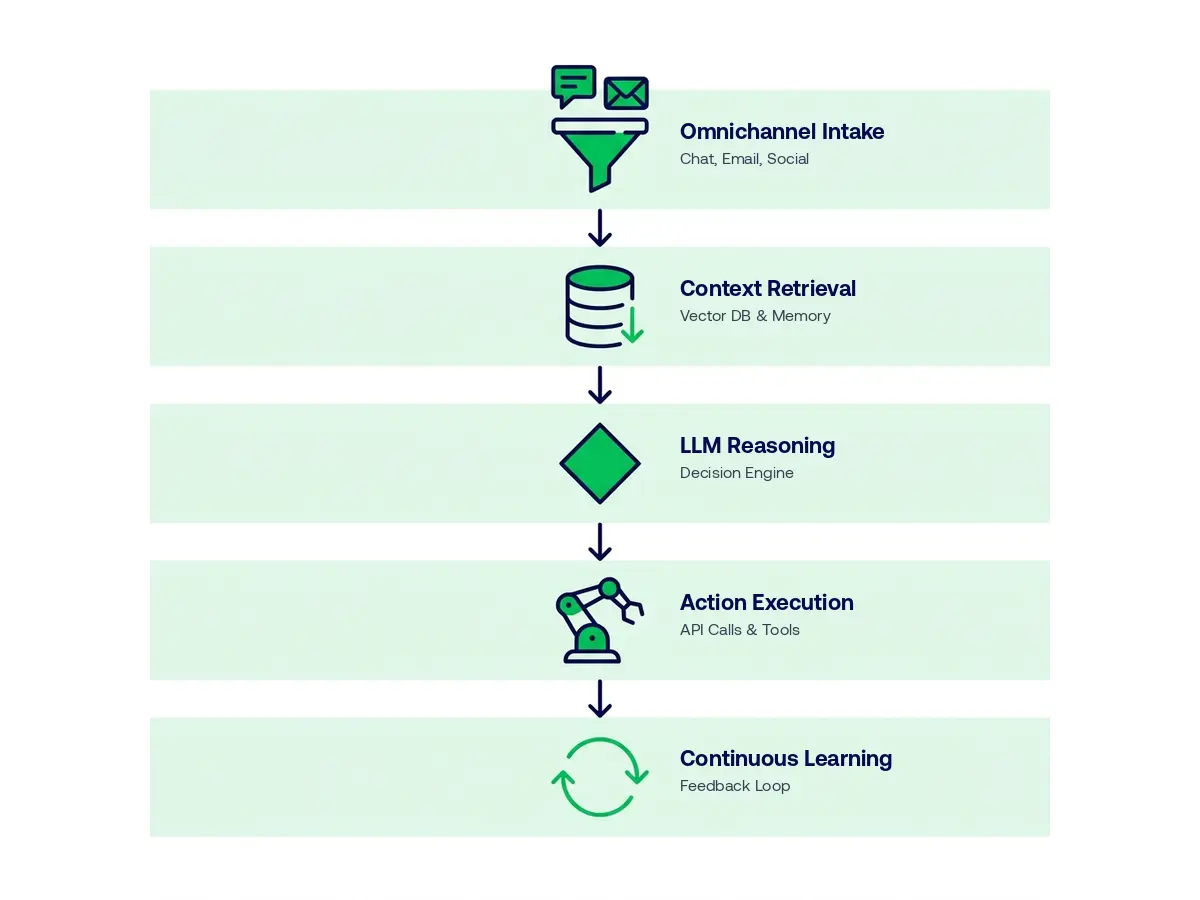
A production AI customer support agent has five layers.
Layer 1: Intake and Classification The agent receives a ticket via email, chat, or API from your helpdesk. It classifies the intent (billing question, bug report, feature request, account issue, shipping question), extracts key entities (order number, product name, account ID), and determines which tool set to use.
Layer 2: Context Retrieval Before responding, the agent pulls relevant context: the customer's account data (tenure, plan, recent orders, past tickets), your knowledge base articles relevant to the classified intent, and any internal notes from previous interactions.
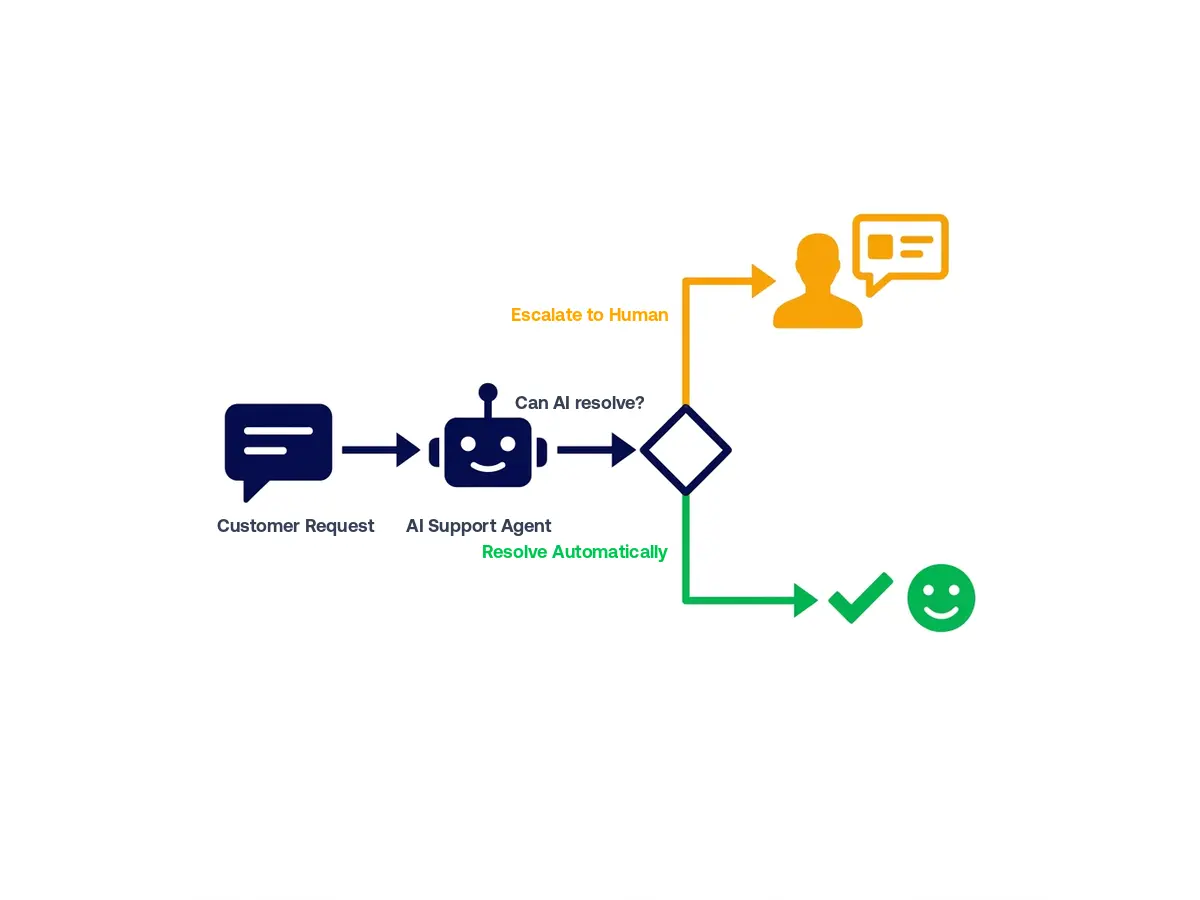
Layer 3: Resolution Logic The agent reasons over the context and intent to determine the resolution path:
- If resolvable with information: draft a response using knowledge base content
- If resolvable with an action: execute the action (process refund, update account, trigger workflow) and confirm to the customer
- If escalation criteria are met: route to a human with full context
Layer 4: Response and Action Execution The agent sends the response or takes the action. For actions (refunds, account changes, ticket status updates), it calls the relevant API with proper authentication and error handling.
Layer 5: Learning Loop Customer and agent feedback (thumbs up/down, CSAT scores, escalation flags) feeds back into prompt refinement and knowledge base updates. This is how your automation rate improves from 50% to 70%+ over time.
The Knowledge Base: Your Agent is Only as Good as This
This is the most important thing most teams get wrong. They deploy an agent connected to a sparse, outdated, or poorly organised knowledge base and then wonder why the resolution quality is poor.
Your knowledge base needs to answer three types of questions well:
Policy questions ("What's your return policy?", "Do you offer refunds?", "How long does shipping take?"): These need authoritative, unambiguous answers. One document per policy, clearly named, regularly updated.
How-to questions ("How do I reset my password?", "How do I cancel my subscription?"): Step-by-step instructions with screenshots where relevant. Tested by someone who hasn't done the task before.
Troubleshooting questions ("My payment isn't going through", "I can't log in", "My order shows delivered but I haven't received it"): Decision-tree style content covering the 5–10 most common causes and their fixes.
Before you build the agent, audit your knowledge base. Give a new team member 20 real past tickets and your knowledge base. Have them try to resolve each one using only those resources. The tickets they can't resolve tell you exactly what content to create first.
A knowledge base audit typically takes 1–2 weeks and costs $2,000–$5,000. It's the highest-ROI pre-build investment you can make.
The Escalation Design: Where Most Agents Fail
The difference between an AI agent customers trust and one they hate is almost entirely in the escalation design.
Escalate immediately on these signals:
- Explicit request to speak to a human ("I want to talk to a person")
- Expressions of significant frustration or distress (strong negative language)
- Billing disputes above a defined threshold
- Legal or compliance language ("I'm going to take legal action")
- Safety-relevant situations (healthcare, financial services)
- Repeated attempts to resolve the same issue (2+ times without resolution)
Escalation mechanics matter as much as escalation triggers. When the agent hands off, the human agent must receive: a concise summary of the customer's issue, all information already gathered, actions already taken, why escalation was triggered, and the customer's sentiment indicator. A human who receives a full context summary can resolve the issue in minutes. A human who has to re-ask everything the bot already asked is a customer experience disaster.
Never let a ticket fall into a void. If your agent escalates and no human picks it up within your defined SLA, the agent should follow up with the customer and set an expectation. Silence after escalation is the worst possible outcome.
Implementation Roadmap
Phase 1: Data Preparation (Weeks 1–3)
Export your last 12 months of resolved tickets. Categorise them by intent type. Identify your top 20 most frequent intents — these are your build targets. Audit and update your knowledge base to cover each one. Connect your knowledge base, helpdesk, and CRM to the agent's data layer.
Phase 2: Build and Internal Testing (Weeks 4–8)
Build the agent handling your top 10 intents first (cover ~60% of volume). Test internally using real past tickets as inputs — measure resolution accuracy before any customer sees it. Target: 85%+ accuracy on test set before proceeding.
Phase 3: Shadow Mode (Weeks 9–10)
Run the agent in parallel with your human team on live tickets. The agent drafts responses; humans review and send. You're measuring where the agent is wrong, not exposing customers to errors. Fix the gaps.
Phase 4: Staged Rollout (Weeks 11–14)
Enable the agent for 20% of tickets (lowest-risk intents first). Measure live CSAT, escalation rate, and resolution accuracy. Expand weekly as metrics stabilise. Target full deployment at week 16.
Phase 5: Continuous Improvement
Review the 30% of escalated tickets weekly. Are there patterns? New issues the agent should handle but doesn't? Update knowledge base and prompts in monthly sprints. Your automation rate grows by 2–5 percentage points per quarter with disciplined iteration.
Metrics That Matter (and What Good Looks Like)
Autonomous resolution rate: Percentage of tickets fully resolved without human involvement. A realistic first-year target is 40–55%; best-in-class deployments with clean data and well-maintained knowledge bases reach 65–75% at steady state. Industry median is around 41% — anything above 50% is strong.
CSAT delta: Your customer satisfaction score should not drop after deploying the agent. If it does, the escalation design or knowledge base quality needs work. Target: CSAT neutral or positive within 60 days.
First response time: AI agents should respond within 30–60 seconds. This alone drives CSAT improvement. Target: under 60 seconds for 95% of tickets.
Escalation quality rate: Of the escalations the agent makes, what percentage actually needed a human? If this is below 70%, the agent is escalating too aggressively and needs calibration. If it's above 95%, the agent may not be escalating enough.
Cost per resolved ticket: Industry benchmarks put total AI resolution cost (API + infrastructure) at $0.40–$1.00 per ticket, versus $7–$25 for human-handled tickets. LLM API costs alone typically run $0.05–$0.40 per ticket depending on model choice and ticket complexity. The economics are compelling regardless of which number you use.
The ROI Calculation
Median business case: 2,000 tickets/month, 12 minutes average handle time, $28/hour fully-loaded agent cost.
Current monthly support cost: 2,000 × (12/60) × $28 = $11,200/month.
Post-agent: 30% handled by humans (the complex 30%). New monthly human cost: 600 × (15/60) × $28 = $4,200/month. (Complex tickets take longer — 15 min average.)
Agent operating cost: ~$300/month (API + infrastructure).
Monthly saving: $11,200 − $4,200 − $300 = $6,700/month.
Build cost (Tier 2 agent): $48,000. Monthly running cost: $300 (API + hosting). Annual maintenance retainer (15% of build): $7,200. Year-one total investment: $58,800.
Year-one saving: $80,400. Year-one ROI: 137%. Payback: under 9 months.
Want to see what a support agent would look like for your business?
We'll audit your current support volume, classify your ticket types, and show you exactly what a 70% automation rate would mean for your team and your costs. Free, no commitment.
Irfan Malik is the CEO and Founder of ibute, with 20 years of experience helping businesses leverage custom software and AI solutions to scale efficiently. He specializes in making complex technology accessible and actionable for business leaders.
Frequently Asked Questions
Will customers know they're talking to an AI?
What happens to my support team if the AI handles 70% of tickets?
What types of tickets can AI agents NOT handle?
How long does it take to implement an AI support agent?
Need a clear path forward?
Get a custom AI roadmap — tailored to your stack, timeline and budget.
Talk to an Expert →