
AI agents that take action, not just chat.
We design, build and deploy custom AI agents that read context, make a decision, and take a real action inside your stack — your CRM, inbox, ticketing system or database. Production-grade, evaluated continuously, and owned end-to-end.
AI agent development is building software that uses a large language model to perceive context, decide what to do, and take an action autonomously — looking up data, calling an API, or completing a multi-step task — rather than just replying with text.
ibute is a custom software and AI development company, founded in 2022 with teams in Austin, TX and Lahore, Pakistan, that builds and operates production AI agents. Roughly 60% of our work is AI-led. We start every agent as a 2–3 week pilot with a measurable kill-or-scale gate — so you see a working agent and a number before committing to a roadmap.
At a glance
- What it is
- Custom-built, action-taking AI agents
- Best for
- Support, sales, ops & internal workflows
- Typical pilot
- 2–3 weeks to a working demo
- Core stack
- OpenAI, Anthropic, LangChain, RAG
- Deploys to
- Your CRM, inbox, tickets, database
- Teams
- Austin, TX + Lahore, Pakistan
What is an AI agent — and how is it different from a chatbot?
The short version: a chatbot answers; an agent acts. Most of what people call 'AI' projects today are really agent projects.
An AI agent is a system built around a large language model (LLM) that can do more than generate a reply. It can read the context of a request, decide which steps to take, call tools and APIs to get information or make changes, and complete a task end-to-end — then check its own work. A chatbot ends at the answer; an agent ends at the outcome.
The practical difference is where the work lands. A chatbot lives on a website widget and hands the conversation back to a human. An agent lives inside your systems — it drafts and sends the email, updates the CRM record, triages the ticket, or runs the multi-step research task. That's the line we use when scoping: if the goal ends in an action inside your stack, you want an agent.
Agents range from simple (one tool, one decision) to complex multi-step or multi-agent systems that plan, retrieve, and verify. We deliberately start at the smallest version that solves the real problem, prove it works against a baseline, then add capability only where the metrics justify it.
What teams hire us to build.
A representative slice — if your workflow ends in an action a person currently does by hand, it's probably a fit.
Customer support agents
Reads the ticket and your knowledge base, drafts or sends a grounded reply, escalates the hard ones to a human with context attached.
Outbound & research agents
Researches a contact, drafts a tailored sequence in your voice, sends from your inbox and auto-replies to easy threads — like ReachStack.
Document & workflow agents
Invoice triage, contract review, document classification, inbox auto-routing — the manual queue that quietly eats a team's week.
Internal copilots
An agent over your wiki, database and tools that answers staff questions and performs the lookups and updates they'd otherwise do by hand.
Research & analysis agents
Multi-step research across internal and public sources, with citations — turning a half-day of manual digging into minutes.
Voice agents
Speech-to-text → LLM → text-to-speech for inbound/outbound calls. We've shipped production voice agents in the past year.
The full agent stack — model to monitoring.
Most agent projects fail at the integration and evaluation layers, not the model. We own all of it.
Agent architecture
Single-agent, multi-agent, or tool-using — designed around your real workflow, not a framework demo.
Reasoning & planning
Task decomposition, tool selection, and self-checking. The agent picks the right step, then verifies it worked.
RAG & retrieval
Grounded answers from your knowledge base via pgvector, Pinecone or Qdrant — so the agent cites, not invents.
Tool & API integration
Connect the agent to your CRM, inbox, tickets, database and internal APIs so it can actually do the work.
Guardrails & safety
Input/output validation, action approvals for high-stakes steps, and scoped permissions. The agent can't do what it shouldn't.
Eval & monitoring
Test sets, accuracy tracking and live monitoring. The unsexy half that decides whether an agent stays in production.
Comparing our delivery model vs. alternatives
| Rule-based chatbot | AI agent | Traditional RPA | |
|---|---|---|---|
| What it does | Answers from a script or FAQ | Reasons, decides and takes actions | Replays fixed UI clicks |
| Handles new situations | No — breaks off-script | Yes — reasons over context | No — brittle to UI changes |
| Takes real actions | Rarely | Yes — calls tools & APIs | Yes, but rigidly |
| Setup effort | Low | Medium — pilot in 2–3 weeks | High & fragile |
| Best for | Simple, repetitive Q&A | Judgement + action workflows | Stable, legacy-UI tasks |
Rule of thumb: if the task needs judgement and ends in an action inside your systems, build an agent. If it's pure scripted Q&A, a chatbot is cheaper. If it's clicking through a legacy app with no API, RPA may still fit.
Pilot, validate, scale.
Every agent engagement starts as a short pilot with a kill-or-scale gate. We don't sell six-month roadmaps on day one.
Pilot
Pick one workflow. Build a working agent against your real data and tools. Measure it vs. the current manual process. Output: a working demo and a number.
Validate
Real users, real edge cases. Hit the target accuracy, cost and latency — or kill it. We'd rather lose the build fee than ship an agent that erodes trust.
Scale
Production deploy, guardrails, evals and monitoring. Most engagements continue on retainer because models drift and the workflow keeps evolving.
Model-agnostic, framework-pragmatic.
We benchmark on your real data before recommending. The right model usually picks itself once you fix two of latency, accuracy and cost.
Where this service has shipped.
Two recent engagements that leaned heavily on this practice. Read the full case studies, or browse all work.
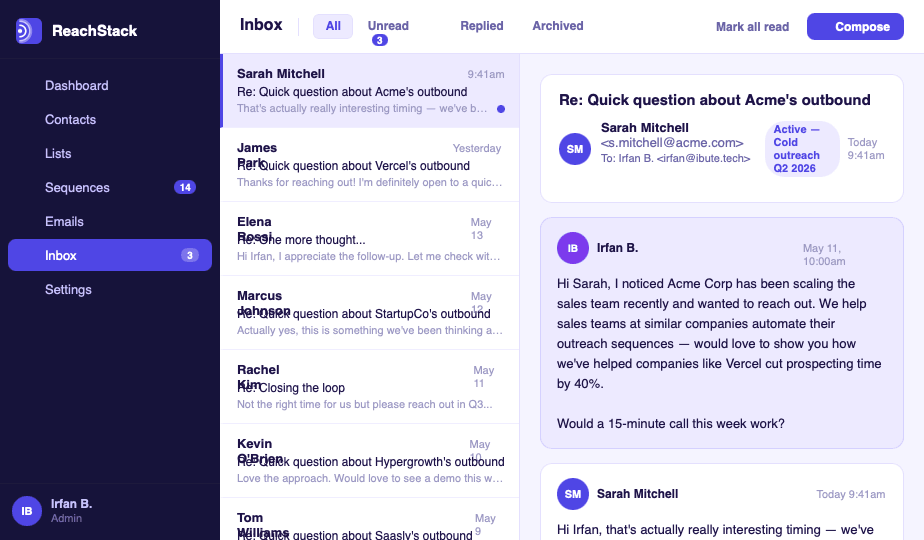
An AI agent that researches, writes and sends — in the rep's voice.
Multi-step research → tailored draft → multi-account send → inbox auto-reply. RAG over a public + internal knowledge base. Evals running continuously.
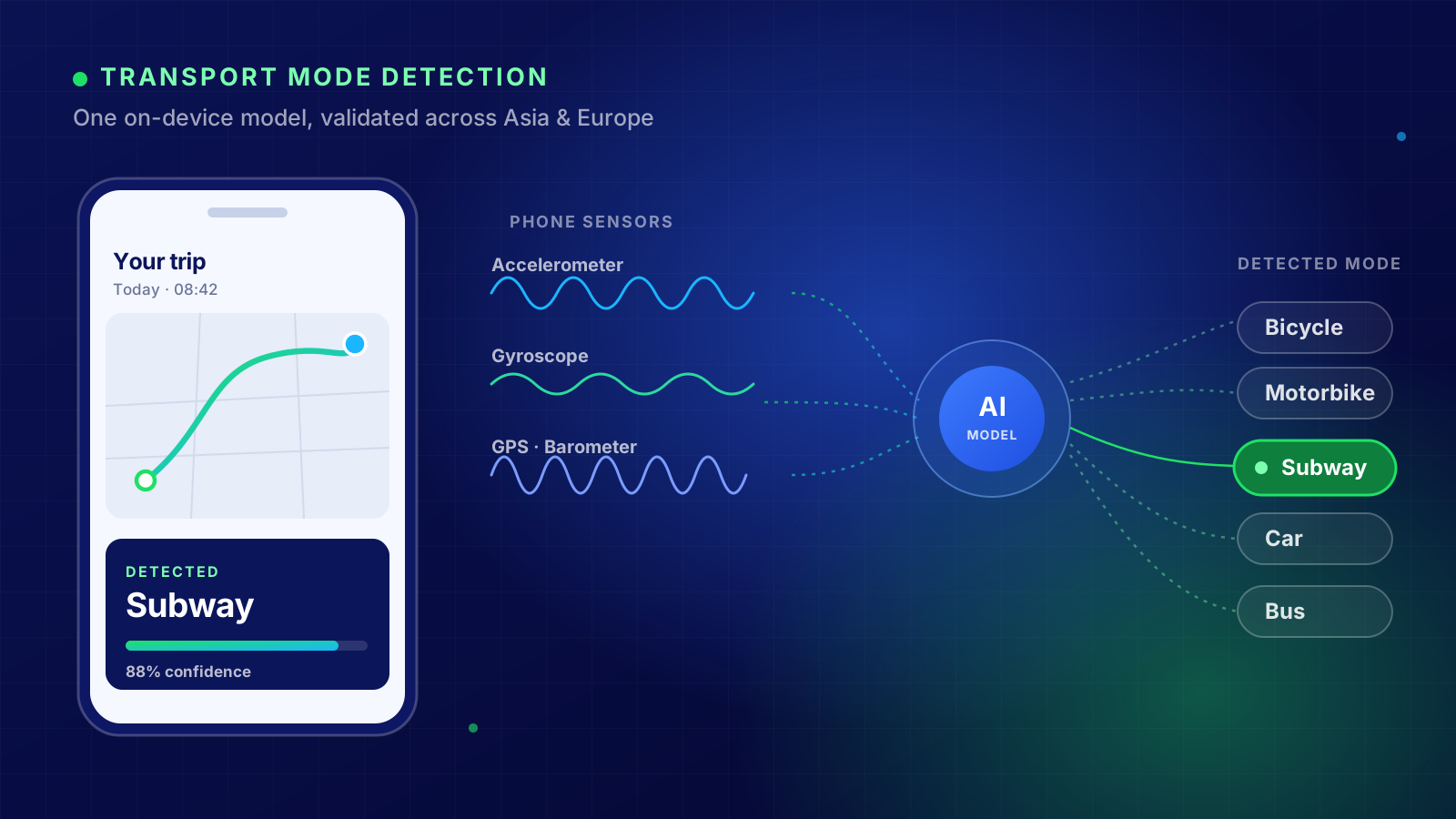
Custom ML model: 88% accuracy detecting how someone is traveling.
Sensor-fusion deep learning across gyroscope, accelerometer, GPS, magnetometer and barometer. Trained on multi-continent data. Inference on-device.
The questions we get most.
Anything else? Email hello@ibute.tech — we reply within 24h.
What exactly is an AI agent?
What's the difference between an AI agent and a chatbot?
How long does it take to build an AI agent?
How much does AI agent development cost?
Will the agent hallucinate or take wrong actions?
Which LLM do you build agents on?
Can the agent run on our own infrastructure?
Do you keep working with us after launch?
AI Solutions
The pillar — agents, custom ML models and automation, all in one place.
AI Agent Development
Autonomous agents that take actions inside your stack.
LLM Integration
Connect GPT, Claude or Gemini into your product, with RAG.
AI Consulting
Find where AI pays off, then de-risk the build.
AI Automation Agency
Replace manual, repetitive workflows with AI.
Get in touch
Have an AI agent in mind?
Free 30-minute review. We'll tell you whether this is the right fit, what the shape of the engagement would look like, and roughly what it costs. No deck. No follow-up unless you ask.
Austin · Lahore · Reply within 24 hours.