
Add GPT, Claude or Gemini to your product.
We integrate large language models into existing software — the API layer, retrieval, prompts, evals, cost controls and security — so a real feature ships to production. Model-agnostic, benchmarked on your data, built to stay grounded.
LLM integration is connecting a large language model — like OpenAI's GPT, Anthropic's Claude, or Google's Gemini — into your existing product or workflow through its API, so the model can read your data, follow your rules, and power a real feature.
ibute is a software and AI development company (founded 2022, with teams in Austin, TX and Lahore, Pakistan) that ships production LLM features end-to-end: API integration, retrieval-augmented generation (RAG), prompt design, evaluation, monitoring and cost control. We benchmark candidate models on your real data before recommending one — sometimes the cheapest model wins, sometimes the workflow needs the frontier one.
At a glance
- What it is
- Connecting an LLM into your software
- Best for
- Adding AI features to an existing app
- Core methods
- RAG, prompt design, fine-tuning
- Models
- OpenAI, Claude, Gemini, Llama
- Data privacy
- Zero-retention or self-hosted options
- Teams
- Austin, TX + Lahore, Pakistan
What does it mean to integrate an LLM?
It's less about the model and more about everything around it — retrieval, prompts, guardrails and evals are where projects succeed or fail.
LLM integration means wiring a large language model into your application so it can do useful work on your data. In practice that's a chain of decisions: which model, how to feed it the right context (retrieval), how to instruct it (prompt design), how to keep it grounded and safe (guardrails), how to know it's working (evals), and how to control latency and cost in production.
The model itself is usually the easy part — it's a few lines to call an API. The hard, valuable work is the integration layer: getting your knowledge base into a vector store, shaping prompts that behave consistently, validating outputs, handling failures gracefully, and keeping the bill predictable when traffic spikes. That's the half most teams underestimate, and the half we specialize in.
Two methods do most of the heavy lifting. Retrieval-augmented generation (RAG) pulls relevant facts from your data at query time so answers stay grounded and current. Fine-tuning adjusts the model's behavior on your examples. We almost always start with prompts plus RAG, and only fine-tune when evals prove we can't hit the target without it.
Everything around the model.
The model is one line of code. These are the parts that make an LLM feature actually work in production.
API integration
OpenAI, Anthropic, Gemini and open-weight APIs wired into your backend — streaming, retries, fallbacks and rate-limit handling included.
RAG & retrieval
Your docs, tickets and database in a vector store (pgvector, Pinecone, Qdrant) so answers cite real sources instead of hallucinating.
Prompt engineering
Structured prompts, output schemas and few-shot examples that make the model behave consistently across edge cases.
Fine-tuning
On your data, in your cloud, only when evals justify it. We start cheap with prompts + RAG and tune as a last step.
Guardrails & privacy
Input/output validation, PII handling, zero-retention modes and self-hosted models for data that can't leave your VPC.
Evals & cost control
Test sets, accuracy tracking, caching and model routing — so quality stays high and the bill stays predictable.
Comparing our delivery model vs. alternatives
| OpenAI GPT | Anthropic Claude | Open-weight (Llama) | |
|---|---|---|---|
| Strengths | Broad ecosystem, tools, speed | Long context, careful reasoning | Full control, no per-token cost |
| Hosting | API (zero-retention available) | API (zero-retention available) | Self-hosted in your VPC |
| Data privacy | Enterprise no-train modes | Enterprise no-train modes | Nothing leaves your infra |
| Cost model | Per token | Per token | Infra only (fixed) |
| Best when | Fast iteration, rich tooling | Long docs, high-stakes output | Strict privacy or high volume |
We're model-agnostic — the highlighted column isn't a default, it's just first in the list. The right pick depends on your latency, accuracy, cost and privacy constraints, which we test against your actual data before recommending.
Benchmark, build, harden.
We prove the approach on your data before building the full feature — so you're not betting the integration on a guess.
Benchmark
Define the task and success metric. Test candidate models and a RAG baseline on your real data. Output: a recommended approach with numbers behind it.
Build
Integrate the API, stand up retrieval, design prompts and output schemas, and wire it into your product behind a feature flag.
Harden
Evals, guardrails, caching, cost monitoring and fallbacks. Ship to production. Most teams keep us on to tune as usage and models evolve.
The integration toolkit.
Proven tools we reach for on most LLM projects. We pick from this set unless your stack demands otherwise.
Where this service has shipped.
Two recent engagements that leaned heavily on this practice. Read the full case studies, or browse all work.
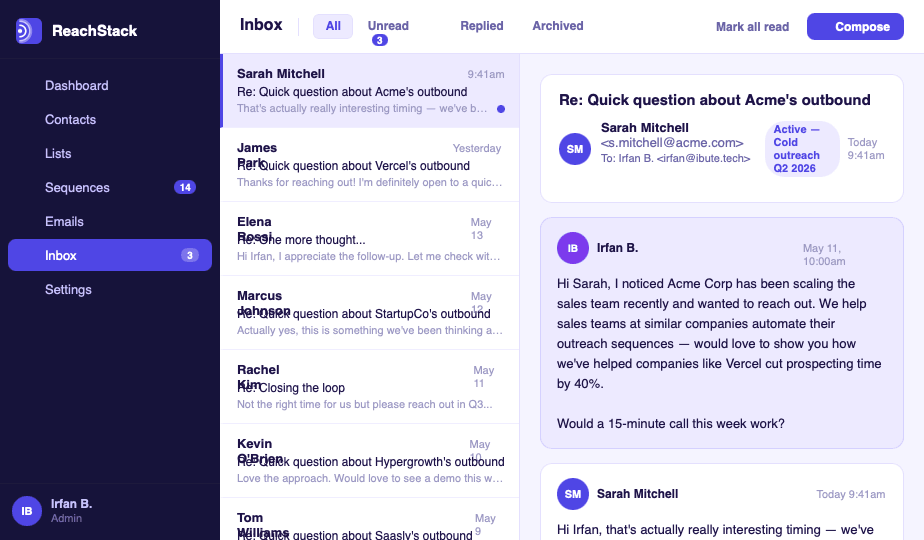
An AI agent that researches, writes and sends — in the rep's voice.
Multi-step research → tailored draft → multi-account send → inbox auto-reply. RAG over a public + internal knowledge base. Evals running continuously.
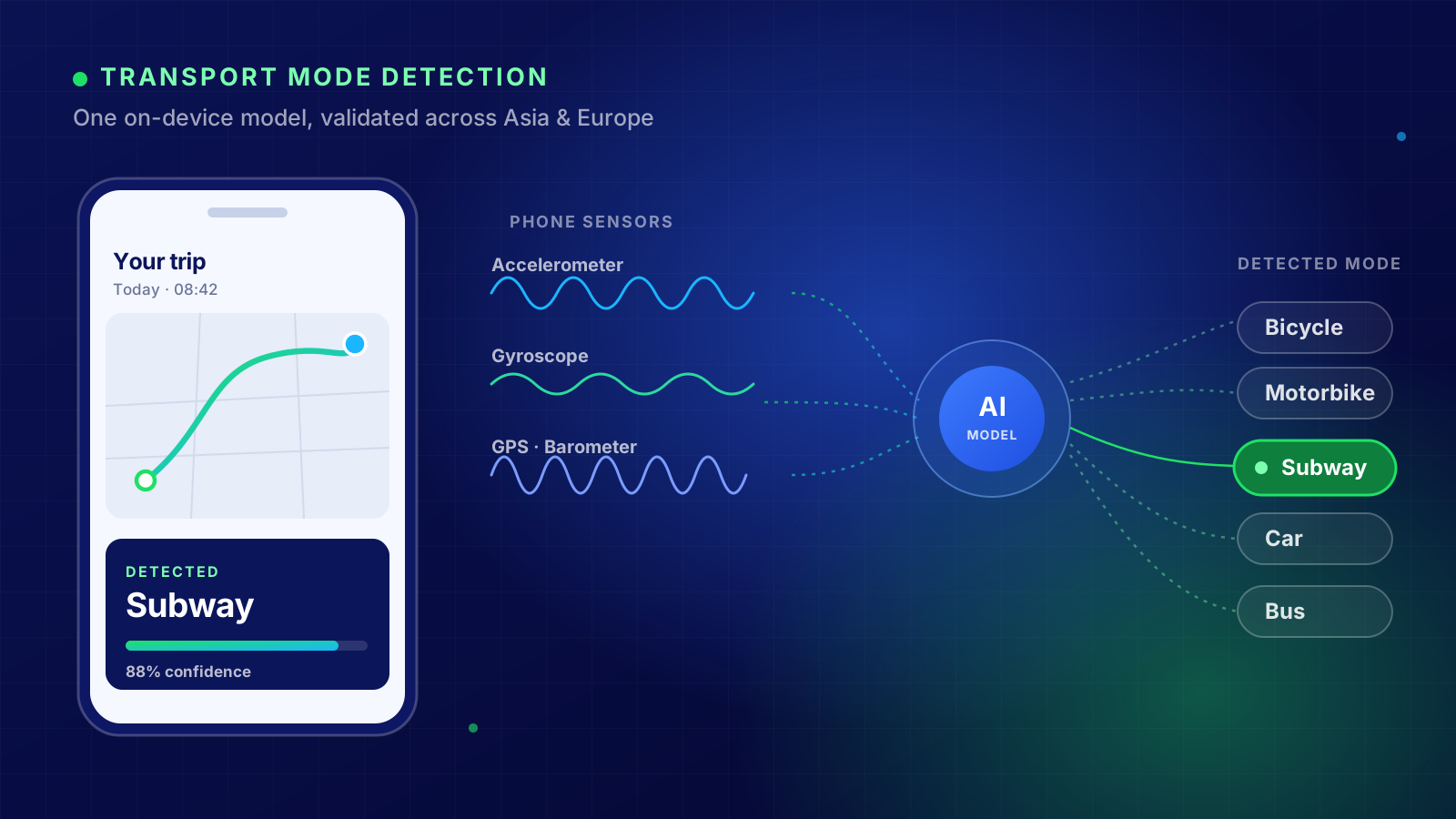
Custom ML model: 88% accuracy detecting how someone is traveling.
Sensor-fusion deep learning across gyroscope, accelerometer, GPS, magnetometer and barometer. Trained on multi-continent data. Inference on-device.
The questions we get most.
Anything else? Email hello@ibute.tech — we reply within 24h.
What is LLM integration?
What's the difference between RAG and fine-tuning?
Which LLM is best to integrate?
Will our data be used to train the model?
How do you stop the LLM from hallucinating?
How long does an LLM integration take?
How do you keep API costs under control?
Can you integrate an LLM into our existing codebase?
AI Solutions
The pillar — agents, custom ML models and automation, all in one place.
AI Agent Development
Autonomous agents that take actions inside your stack.
LLM Integration
Connect GPT, Claude or Gemini into your product, with RAG.
AI Consulting
Find where AI pays off, then de-risk the build.
AI Automation Agency
Replace manual, repetitive workflows with AI.
Get in touch
Ready to add an LLM to your product?
Free 30-minute review. We'll tell you whether this is the right fit, what the shape of the engagement would look like, and roughly what it costs. No deck. No follow-up unless you ask.
Austin · Lahore · Reply within 24 hours.