When you decide to build an AI agent, one of the first decisions is which framework to use. Pick well and you ship faster, debug easier, and maintain less. Pick wrong and you're fighting your tools instead of solving your problem.
The three dominant frameworks in 2026 are LangChain, LlamaIndex, and Pydantic AI. They overlap in capability but differ meaningfully in philosophy, maturity, and where they excel.
This comparison draws on published benchmarks, community-reported production experience, and real-world deployment patterns.
The 30-Second Summary
- LangChain: Most flexible and feature-rich. Best for complex agents with many tools and integrations. Higher learning curve. Largest ecosystem.
- LlamaIndex: Purpose-built for data pipelines and RAG. Best when your agent needs to reason over large, heterogeneous document sets. Simpler for knowledge-retrieval use cases.
- Pydantic AI: Most developer-friendly. Best for production-grade agents where structured outputs and type safety matter. Least mature but fastest-growing in 2026.
Framework choice is a secondary concern. The most important decisions are your use case definition, architecture, and data design. A mediocre choice of framework with a great architecture beats a great framework with a poor architecture every time.
LangChain
What It Is
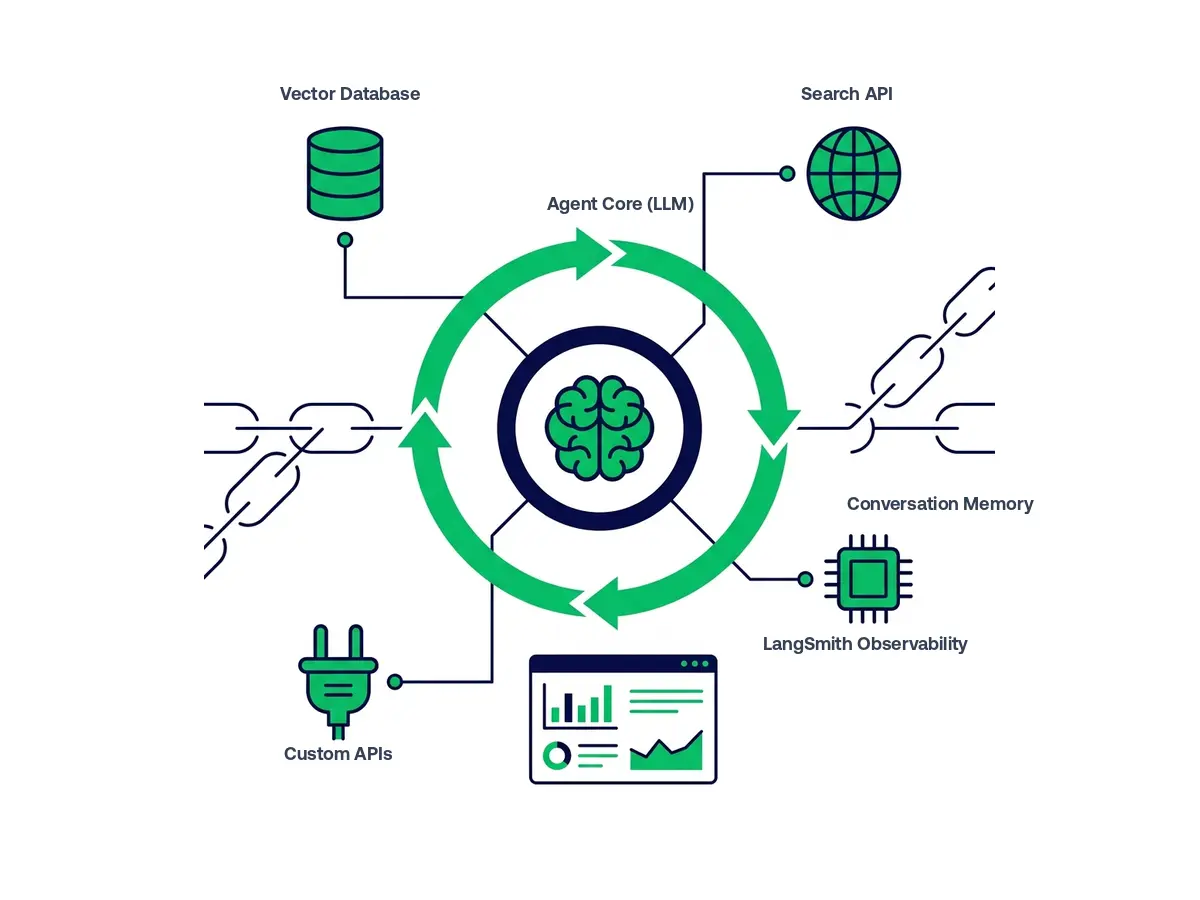
LangChain is a Python (and JavaScript) framework for building LLM-powered applications. It provides abstractions for chains (sequences of LLM calls and tool use), agents (autonomous reasoning loops), and memory. It's the oldest and most widely adopted of the three.
What It Does Well
Ecosystem depth. LangChain has integrations with virtually every vector database, LLM provider, document loader, and external tool you'll encounter. When you need to connect to Salesforce, MongoDB, Stripe, or a custom API, there's almost certainly a LangChain integration already.
LangSmith for observability. LangSmith is LangChain's tracing and monitoring platform. In production, understanding why your agent made a decision is critical. LangSmith gives you full visibility into every LLM call, tool invocation, and reasoning step. This alone justifies LangChain for many teams.
Mature agent patterns. ReAct, Reflexion, tool-calling agents — LangChain has battle-tested implementations of every major agent pattern. You don't have to build them from scratch.
Where It Breaks Down
Complexity accumulates. LangChain's abstraction layers can make simple things complicated and complex things opaque. Debugging a multi-step chain where something goes wrong mid-way requires understanding multiple abstraction layers.
API surface instability. LangChain has a history of breaking API changes between versions. The v0.x series went through several non-trivial migrations before stabilising at v1.x (the current major version). Mitigate by pinning your version and testing upgrades deliberately — do not auto-update in production.
Overkill for simple agents. If you're building a single-tool agent that answers questions from a knowledge base, LangChain is often too much. Start simpler.
Best For
- Agents that use 5+ tools and integrate with many external systems
- Teams that need production observability from day one
- Projects where the ecosystem saves development time on integrations
- Multi-agent coordination: LangGraph (LangChain's graph-based orchestration layer) is the top choice here
LlamaIndex
What It Is
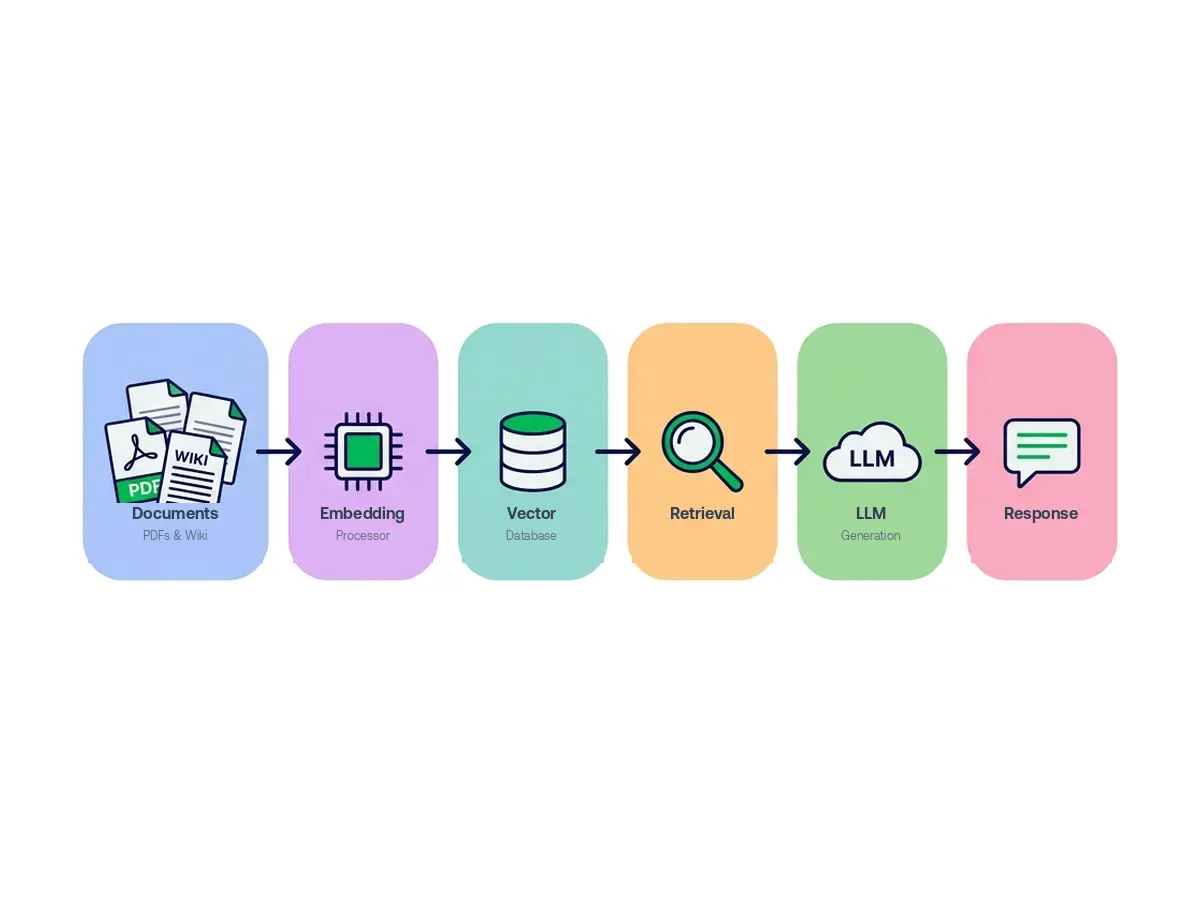
LlamaIndex started as a data framework for LLM applications, specifically for building RAG (Retrieval-Augmented Generation) pipelines. It has expanded into a general agent framework, but its DNA is in data ingestion, indexing, and retrieval.
What It Does Well
RAG pipelines, best in class. If your agent's primary job is to reason over documents (PDFs, wikis, databases, emails), LlamaIndex's ingestion, chunking, indexing, and retrieval abstractions are the most mature available. It handles heterogeneous data sources (multiple file types, formats, and databases) with minimal custom code.
Query engines and data agents. LlamaIndex's data agents (which reason over structured and unstructured data simultaneously) are particularly powerful for analytics-adjacent use cases. Ask a question that requires joining data from a PDF and a SQL database and LlamaIndex handles this more cleanly than the alternatives.
Simpler API for knowledge tasks. For RAG-centric use cases, LlamaIndex code is significantly more readable than the equivalent LangChain code. Less indirection, fewer abstraction layers.
Where It Breaks Down
Tool-use agents are secondary. LlamaIndex's agent framework for tool-calling (non-RAG tasks) is less mature than LangChain's. For agents that primarily take actions rather than answer questions, you'll run into limitations.
Smaller ecosystem. Fewer third-party integrations than LangChain. Not a dealbreaker. The core data connectors are comprehensive, but you'll write more custom integration code for external SaaS tools.
Less production tooling. LlamaIndex's observability story is not as mature as LangSmith. You'll need to integrate a third-party tool (Arize, Traceloop) for production monitoring.
Best For
- Customer support agents grounded in product documentation
- Internal knowledge assistants over company wikis and files
- Agents that need to reason over complex document collections
- Research and analysis agents working across multiple data sources
Pydantic AI
What It Is
Pydantic AI is a newer framework built by the team behind Pydantic, the Python data validation library. It takes a fundamentally different philosophy: instead of chaining prompts and tools together, it treats AI agents as typed Python functions. Structured outputs and type safety are first-class citizens.
What It Does Well
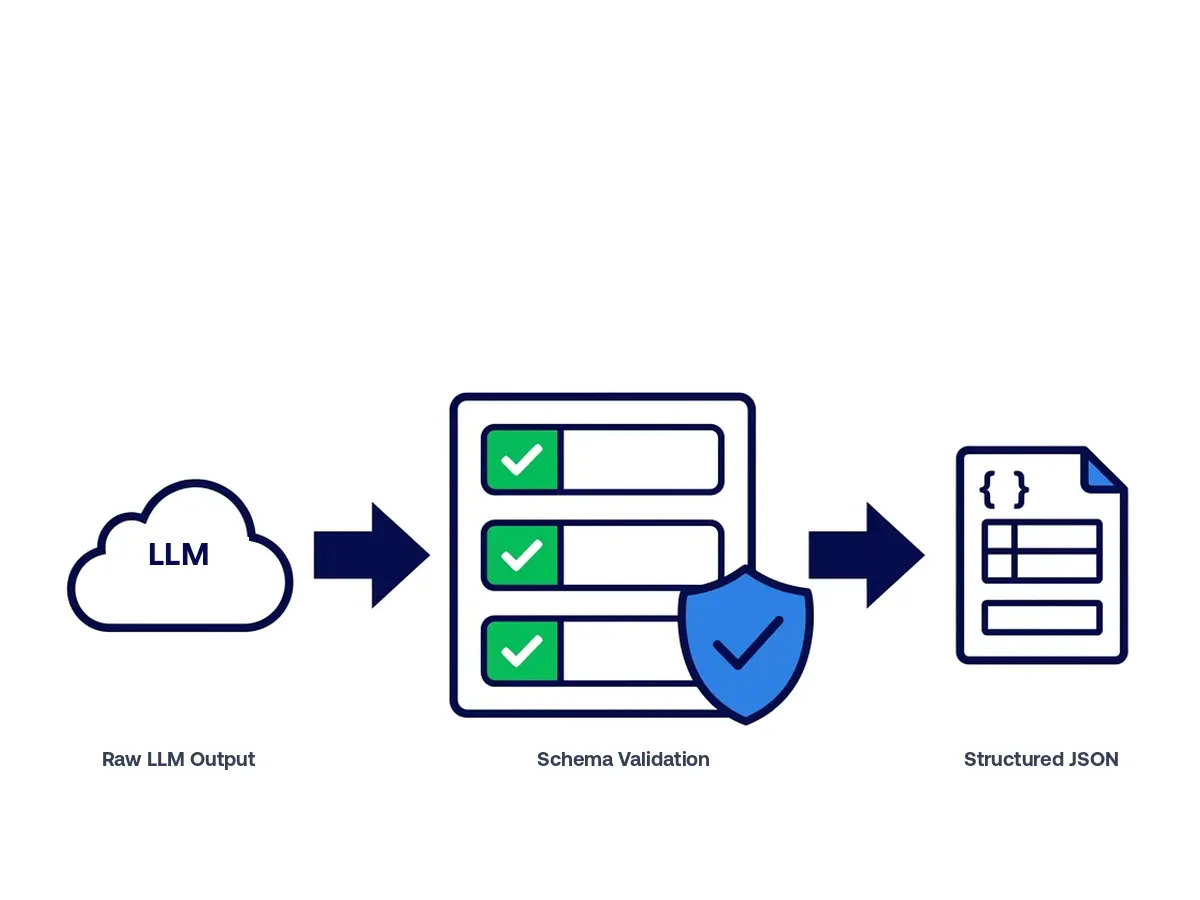
Type safety and structured outputs. Pydantic AI's core strength is guaranteed structured outputs from LLM calls. You define a Pydantic model for what you expect back, and the framework handles the prompt engineering, validation, and retry logic to ensure you get it. For production agents where downstream systems need predictable data, this is a significant reliability advantage.
Clean, readable code. Pydantic AI agents read like normal Python code. No chains, no callbacks, no framework-specific DSL. Developers new to the codebase can understand it without learning the framework's abstractions.
Dependency injection. Pydantic AI's dependency injection system (passing runtime context to agent tools) is elegant. No global state, no threading issues, no context manager gymnastics.
Where It Breaks Down
Younger and smaller ecosystem. Pydantic AI launched in late 2024 and has grown quickly, but the ecosystem of integrations is still smaller than LangChain's. Expect more custom integration work.
Less guidance on complex patterns. For advanced multi-agent orchestration or complex memory patterns, there's less community documentation and fewer battle-tested patterns to reference.
Evolving API. Pydantic AI reached V1 (stable API) in late 2025 and is now moving through V2 beta — meaning another round of API changes is coming. Pin your version and monitor the changelog. Less field-tested than LangChain v1.x for large-scale production deployments.
Best For
- Agents that integrate with structured business systems (invoices, forms, CRMs)
- Teams that value code maintainability and want type-safe contracts with LLMs
- Developers who find LangChain's abstractions frustrating
- Use cases where downstream systems need guaranteed output schemas
Side-by-Side Comparison
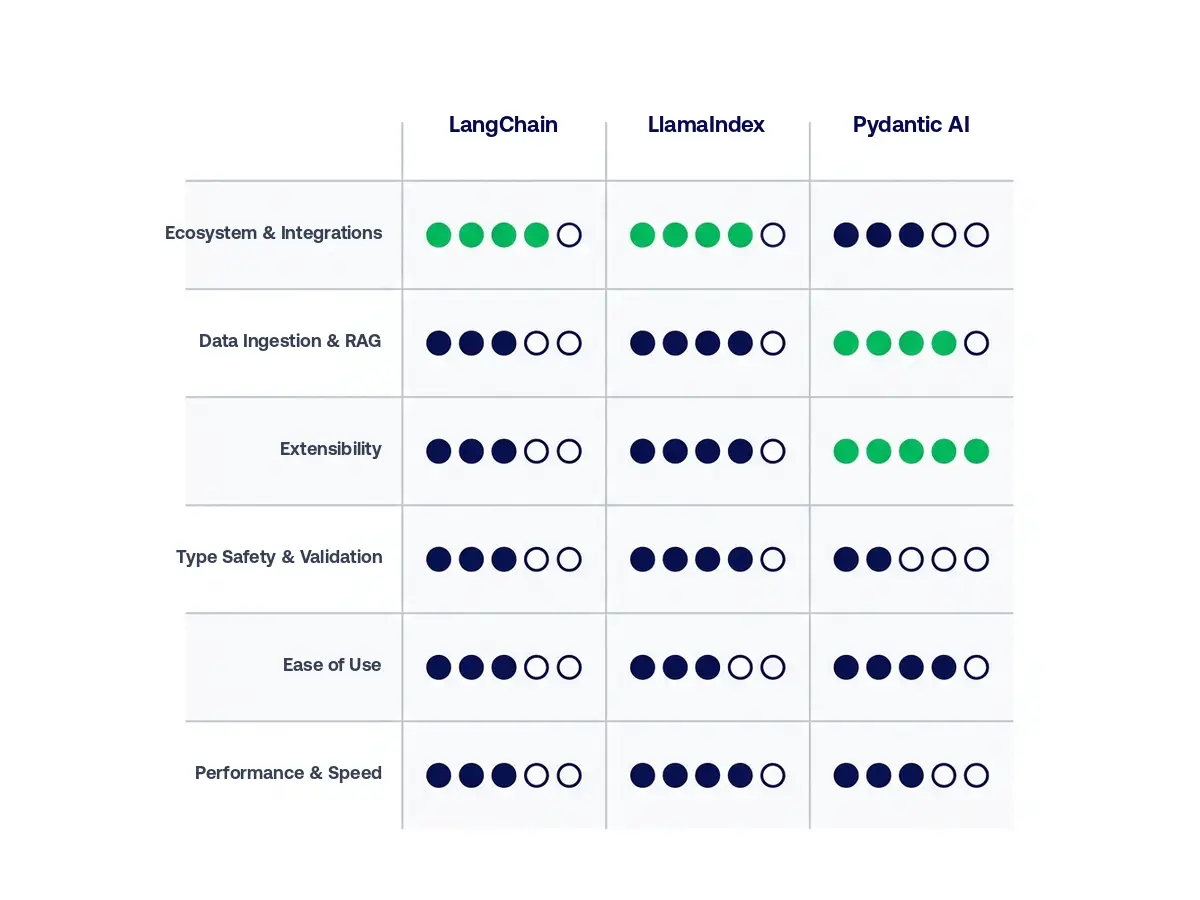
The key dimensions to evaluate for your project:
RAG / document retrieval: LlamaIndex > LangChain > Pydantic AI
Tool-calling / action agents: LangChain > Pydantic AI > LlamaIndex
Structured outputs / type safety: Pydantic AI > LangChain > LlamaIndex
Production observability: LangChain (LangSmith) > LlamaIndex > Pydantic AI
Learning curve: Pydantic AI < LlamaIndex < LangChain
Ecosystem / integrations: LangChain > LlamaIndex > Pydantic AI
Multi-agent coordination: LangChain (LangGraph) > others
How to Choose
Building a support or knowledge agent? Start with LlamaIndex. If you outgrow it, migrating to LangChain is manageable.
Building a workflow or action agent? Start with Pydantic AI if your team knows Python well and values clean code. Use LangChain if you need its ecosystem or LangSmith observability.
Building multiple agents that coordinate? LangGraph — LangChain's graph-based orchestration layer — is currently the best option for multi-agent systems. It handles conditional routing, shared state, and parallel execution across agents cleanly.
Unsure? Build a 2-day proof-of-concept with Pydantic AI. It's the fastest to get off the ground, and the forced structure reveals architectural decisions you'd otherwise defer until they're expensive to change.
A Note on Framework-Agnostic Architecture
The best insurance against a poor framework choice is building your business logic separately from your AI layer. If your agent tools, data models, and workflow logic live in clean Python (or TypeScript) and the framework is just the orchestration layer around them, switching frameworks is a 2-week refactor, not a 2-month rewrite.
This architectural discipline pays dividends regardless of which framework you choose — because the frameworks will keep evolving, and what's best today may not be best in 18 months.
Not sure which stack is right for your agent?
We'll review your use case, your team's technical skills, and your infrastructure and give you a concrete recommendation — including a sample architecture diagram. No cost, no commitment.
Irfan Malik is the CEO and Founder of ibute, with 20 years of experience helping businesses leverage custom software and AI solutions to scale efficiently. He specializes in making complex technology accessible and actionable for business leaders.
Frequently Asked Questions
Can I switch frameworks later if I choose the wrong one?
What about AutoGen, CrewAI, and other frameworks?
Which framework works best with Claude or GPT-5?
Is LangChain still worth learning given its complexity reputation?
Need a clear path forward?
Get a custom AI roadmap — tailored to your stack, timeline and budget.
Talk to an Expert →