When building an AI agent, one decision shapes your architecture, your costs, and your maintenance burden more than any other: how will the agent access the specific knowledge it needs?
Two approaches dominate: RAG (Retrieval-Augmented Generation) and Fine-Tuning. They're often presented as competing options. They're not — they solve different problems. Choosing between them isn't a matter of which is "better"; it's a matter of which problem you actually have.
This guide will tell you which problem you have.
What Each Technique Actually Does
Before comparing them, be precise about what each technique is doing.
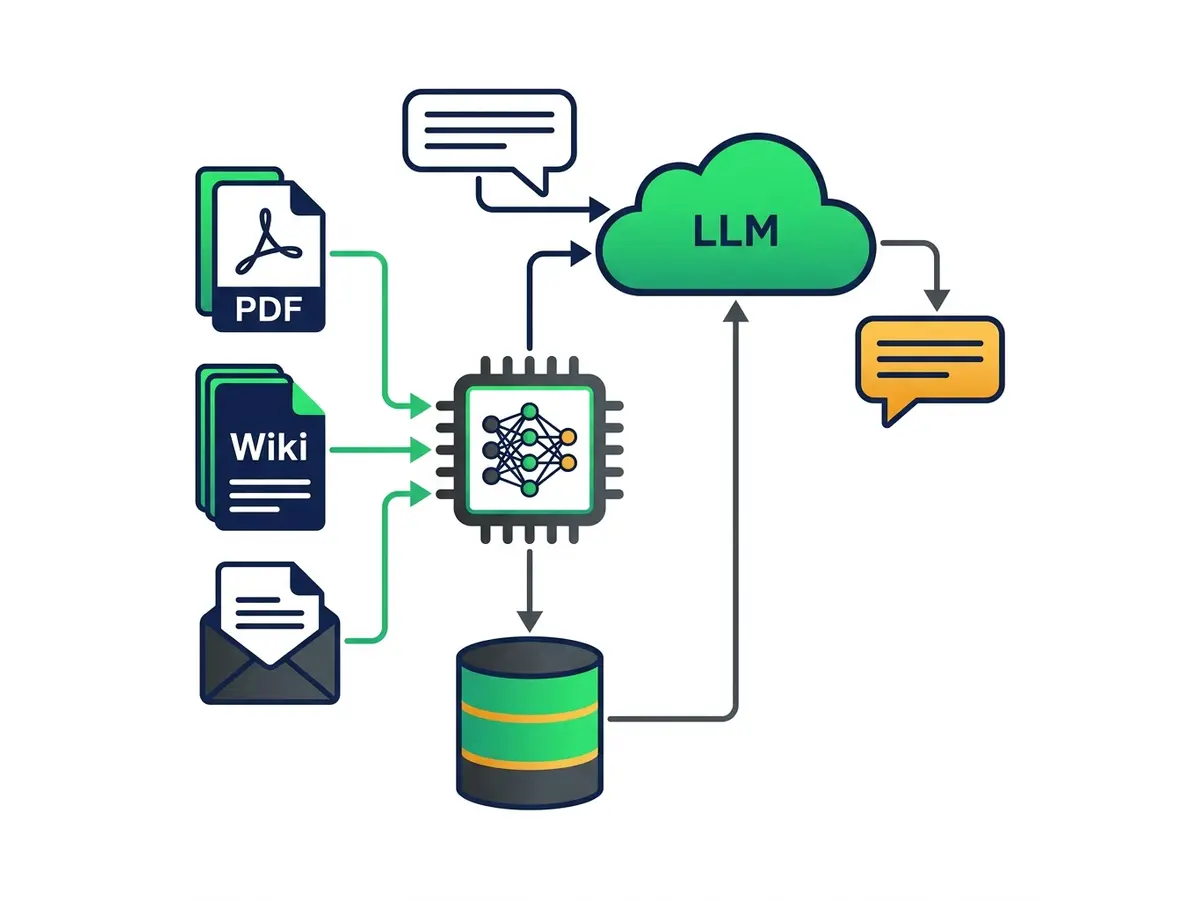
RAG keeps the base model unchanged. At query time, it retrieves relevant documents from an external knowledge base and injects them into the prompt as context. The model reasons over what you give it in that moment.
Fine-tuning changes the model's weights. You provide example input-output pairs, and the model trains to adjust its behaviour: style, format, terminology, and domain-specific patterns. The knowledge becomes part of the model itself.
Think of it this way: RAG is like giving an expert a reference library to consult before answering. Fine-tuning is like training an apprentice until the knowledge is in their head. One is faster to update; the other is always available without looking anything up.
They're built to solve different problems. People mix them up because both are often described as solutions to "my AI doesn't know about my business." That's true — but the reason it doesn't know matters.
When to Use RAG
RAG is the right choice when your agent needs access to specific, changing, or proprietary information that wasn't in the base model's training data.
The Right Scenarios
Your knowledge base changes frequently. Product documentation, pricing, policies, and support procedures change. With RAG, you update a document in your knowledge base and the agent uses the new version on the next query. With fine-tuning, every update requires a new training run.
You need source citations. RAG retrieves the source documents it used to generate a response, making it straightforward to show "this answer came from this document." Fine-tuned models can't reliably cite their sources because the knowledge is distributed across model weights.
You have a large volume of specific information. A product documentation set with thousands of articles, a legal knowledge base with hundreds of contracts, a support knowledge base with years of resolved tickets — RAG handles any size corpus efficiently. Fine-tuning has practical limits on how much domain knowledge you can inject.
You're working with sensitive data. RAG keeps your proprietary information in your infrastructure (your vector database). Fine-tuning with sensitive data means sending that data to an LLM provider for training — a significant compliance concern for regulated industries.
How Good RAG Looks in Practice
A well-implemented RAG pipeline for a support agent:
- Receives a customer question
- Converts it to an embedding vector
- Searches a vector database of product docs, policies, and past resolved tickets
- Retrieves the 3–5 most semantically relevant chunks
- Injects them into the LLM prompt with the customer question
- Generates a response grounded in those retrieved documents
The result: the agent answers using your specific product knowledge, not generic LLM training data, and the answers update automatically when you update your knowledge base.
When RAG Struggles
RAG is not a silver bullet. It underperforms when:
- Your queries require global reasoning across your entire document corpus (not retrieval of specific relevant sections)
- Your documents are poorly written, inconsistently structured, or use inconsistent terminology
- Latency is critical and adding a retrieval step is too slow
- The knowledge needed isn't in documents at all — it's in the model's reasoning patterns
When to Use Fine-Tuning
Fine-tuning is the right choice when you need the model to behave differently, not just know different things.
The Right Scenarios
Consistent tone, style, or brand voice. If your agent needs to respond in a specific register (formal, casual, technical, concise) and the base model's style doesn't match, fine-tuning on examples of your preferred output is the most effective fix. Prompt engineering can approximate this but rarely achieves the consistency of fine-tuning.
Domain-specific formats and structure. Medical documentation, legal filings, financial reports, and code in specific frameworks have highly specific structural requirements. Fine-tuning on examples trains the model to output the right format reliably.
Reducing verbosity or changing response patterns. If you need the model to give shorter answers, avoid certain phrasings, or follow a specific reasoning structure, fine-tuning is more reliable than instruction prompts (which degrade under multi-turn conversations).
High-volume low-cost inference. Fine-tuned smaller open-source models (Llama 3 70B, Mistral 7B, Qwen 2.5) can match a frontier model's performance on a narrow task at a fraction of the cost. If you're running millions of queries on a specialised task, the economics are compelling. Self-hosted fine-tuned models can cost 10–20× less per token than frontier model APIs at scale.
The Fine-Tuning Data Requirement
Fine-tuning requires a labelled dataset: input-output pairs that show the model exactly what you want. Typical minimum: 50–100 high-quality examples for minor adjustments; 500–2,000 for significant behaviour changes; 5,000+ for domain-specific capability changes.
Creating this dataset is the hard part. It requires subject matter experts who can produce or validate hundreds of examples of correct outputs. This is where fine-tuning projects fail: the dataset is too small, too low quality, or not representative of real-world inputs.
When Fine-Tuning Doesn't Work
Fine-tuning cannot:
- Teach the model information it couldn't have reasoned to on its own
- Update the model's knowledge after training (it reflects your training data, which becomes stale)
- Fix reasoning failures: if the base model lacks the reasoning capability, fine-tuning on the task won't fix it
- Replace RAG for large, frequently updated knowledge bases
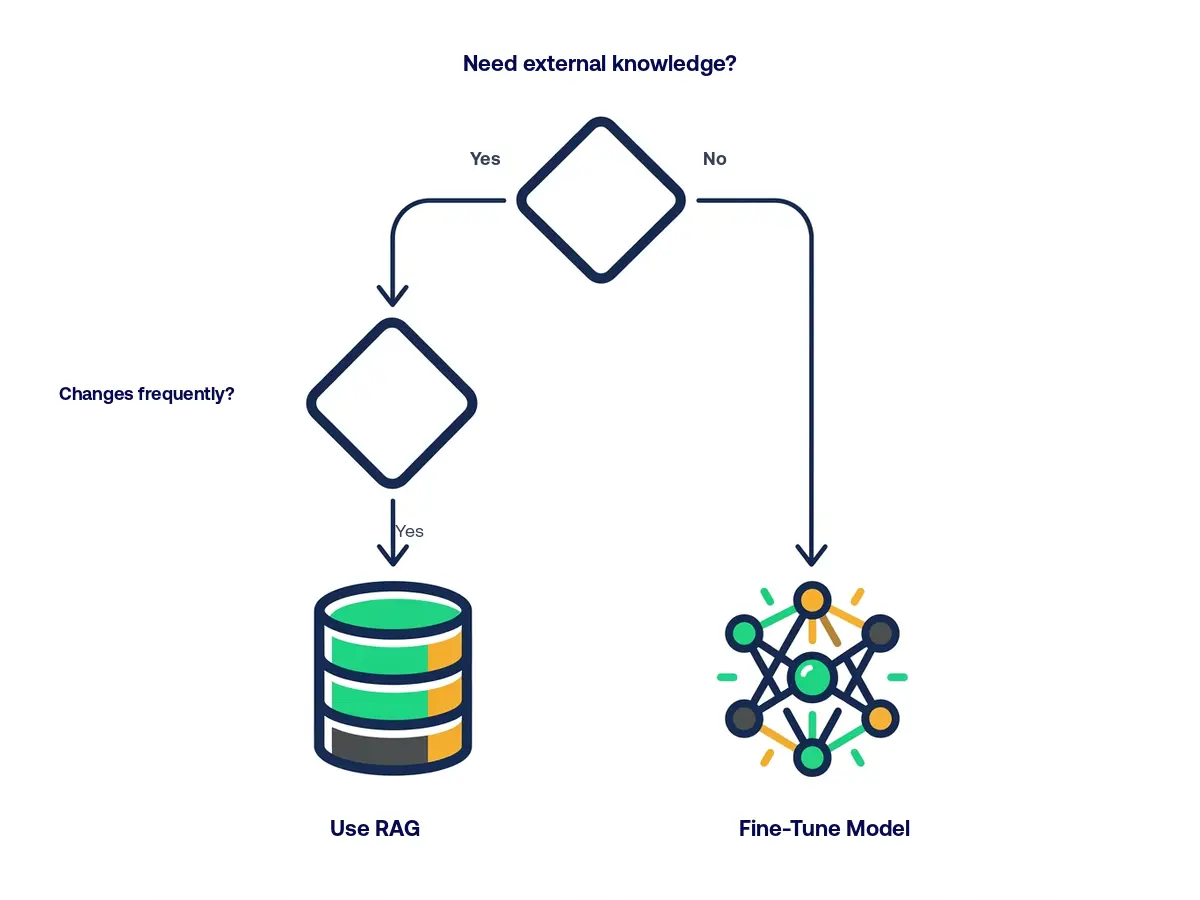
The Decision Framework
Work through these four questions in order.
1. Is the problem that the model doesn't have the right information? → If yes: RAG. The model needs access to your specific documents, data, or records. Fine-tuning won't help here.
2. Is the problem that the model's information changes frequently? → If yes: RAG. Fine-tuning a new model for every knowledge update is impractical.
3. Is the problem that the model's behaviour (style, format, tone) is wrong? → If yes: Fine-tuning. Prompt engineering is your first attempt; fine-tuning if prompts don't achieve the consistency you need.
4. Is the problem that the model is too expensive or slow at scale? → Consider fine-tuning an open-source model on your specific task. A fine-tuned Llama 3 70B or Mistral model can match frontier model performance on a narrow domain task at 10–20× lower inference cost when self-hosted or run via a specialised inference provider.
The 80% answer: For most business AI agent use cases in 2026, RAG is the right starting point. Fine-tuning is an optimisation you consider after you have a working RAG system and have identified specific behavioural issues that prompting can't solve. Don't fine-tune as your first move.
The Third Option: Better Prompting
Before investing in either RAG infrastructure or fine-tuning, exhaust prompt engineering. Modern LLMs (Claude Sonnet 4, GPT-5.3 Instant, Gemini 2.0 Flash, and similar frontier models) respond dramatically to well-crafted prompts.
What prompt engineering can fix without RAG or fine-tuning:
- Response format and structure (use XML tags or JSON schemas in your prompt)
- Tone and formality (system prompt instructions are surprisingly effective)
- Task focus (constraining the model to specific types of responses)
- Reasoning steps (Chain-of-Thought prompting for complex decisions)
What prompt engineering cannot fix:
- Access to information not in the model's training data
- Consistency at scale (long multi-turn conversations degrade instruction-following)
- Cost at high volumes (bigger models with longer prompts are expensive)
The practical sequence: prompt engineering first → RAG when you need your specific data → fine-tuning when you need consistent behaviour at scale or lower cost.
Evaluating Your RAG Quality
One of the most common failures in RAG implementations is deploying a pipeline without measuring its quality. Two metrics to track from day one:
Retrieval precision: Of the documents your retrieval step returns, what percentage are actually relevant to the query? Low retrieval precision means the model is reasoning over irrelevant context — producing hallucinations or irrelevant responses.
Answer faithfulness: Does the generated answer stay grounded in the retrieved documents, or does it introduce information that wasn't in the retrieved context? High faithfulness means your agent is using your knowledge base as intended. Low faithfulness indicates prompt design issues.
Tools like RAGAS (an open-source evaluation framework) automate these measurements. Building evaluation into your RAG pipeline before launch catches quality issues before customers do.
Practical Starting Points
For a support agent: Start with RAG over your knowledge base and resolved ticket history. Measure retrieval precision and answer faithfulness. Optimise your chunking strategy (how you split documents) before touching the model. Fine-tune only if tone consistency becomes a persistent issue after prompting attempts.
For a data extraction agent (invoices, contracts, forms): Fine-tuning a smaller model on examples of your specific document format often outperforms RAG. The task is format-pattern recognition, not knowledge retrieval.
For an internal assistant: RAG over your company wiki, Notion, Confluence, or SharePoint is almost always the right choice. This information changes constantly; you need source citations; and you want updates to take effect immediately.
Not sure which approach fits your use case?
We'll review your specific agent requirements and recommend the right architecture — RAG, fine-tuning, or a hybrid. We'll also flag the data requirements and likely costs for each path. Free, no obligation.
Irfan Malik is the CEO and Founder of ibute, with 20 years of experience helping businesses leverage custom software and AI solutions to scale efficiently. He specializes in making complex technology accessible and actionable for business leaders.
Frequently Asked Questions
Can I use RAG and fine-tuning together?
How much does fine-tuning cost compared to RAG?
Does fine-tuning make a model smarter?
What's a vector database and do I always need one for RAG?
Need a clear path forward?
Get a custom AI roadmap — tailored to your stack, timeline and budget.
Talk to an Expert →